Showing posts with label Culture. Show all posts

Thursday, September 22, 2011

Hồ Chí Minh's Name

胡志明

I'm deliriously elated. I just recognized all the characters in Hồ Chí Minh's name as it's written in chữ Nôm. I realized this as I'm sitting in a principal's office, taking a break between classes. I'm here working part time teaching English to 12-year-olds. It's also one of the first times I've ever been in a principal's office without having been sent there by a frustrated teacher who's had it up to here with my shenanigans.

I'm staring at a plaque that hangs above the window overlooking the school's courtyard. The plaque bears the smiling face of Uncle Hồ, as he's affectionately called by many here in Vietnam. The plaque depicts his name in the traditional Vietnamese script, which is essentially Chinese characters that were borrowed and adapted. These characters on the plaque appear exactly the same in Chinese as they do in chữ Nôm.


I recognize the first character from early this summer, when I had started to learn about the the Chinese two-stringed violin. In Chinese, the instrument is called èrhú, or 二胡. The name of this instrument in Vietnamese is đàn hồ. Đàn is Vietnamese for stringed instrument, and hồ is borrowed from the Chinese word hú. It's also the same hồ as in Uncle Hồ.

On this plaque bearing Uncle Hồ's picture, I saw the character for hú. The Vietnamese word hồ has a different meaning than its Chinese root word. In modern Chinese, hú means barbarian, foreigner, or wild, and it could mean recklessly or foolishly. And what's more, it's paradoxically both a common Chinese surname, and a term for someone from beyond China's borders. In chữ Nôm, the character 胡 has two pronunciations: hồ and hò. Hò means to sing, or to acclaim, and the only meaning of hồ is a surname.

志明
The other two characters on the plaque are Chí and Minh, and these are Uncle Hồ's given name. I didn't recognize how to say chí, or what it meant. But I recognized the two characters that chí is made of. The top one means scholar or officer. The bottom one means heart, mind, and soul. Poetic, I know: the mind of the scholar, the heart of the soldier. In chữ Nôm, the character chí means to have will power, or to be pious. Minh is one of the coolest words. The two characters that make up minh are the sun and the moon. In Chinese, this character is means bright, in the sense of light. However, in Vietnamese the word describes someone who is insightful and wise.

I suppose it's worth a mention, in a post about Hồ Chí Minh's name, that this was a name he chose for himself. It's also worth a mention that he held many names. When he was born, he was called Nguyễn Sinh Cung, and was given a new first name, Tất Thành, when he turned 10. In his twenties, he took the name Văn Ba. By the time he reached his thirties, he called himself Nguyễn Ái Quốc. He held this name for most of his adult life, aside from two visits to China in which he went by Lý Thụy and Hồ Quang respectively, a stay in Siam (now known as Thailand) when he was known as Thầu Chín, a period in Hong Kong when he was known as Tống Văn Sơ, and a visit to Moscow, when he called himself Lin. When he returned to Vietnam, he went by Già Thu before finally calling himself Hồ Chí Minh. Today, people call him Uncle Hồ.

Mind you, it wasn't me who imposed an archaic representation of Uncle Hồ's name upon him. I'm only reporting on the plaque hanging in the principal's office. Someone in charge of deciding what should be displayed in this institution of higher learning felt that the chữ Nôm version of Uncle Hồ's name would enrich the students' education. The decision might have been in deference to Uncle Hồ's early career, when he taught chữ Hán, or Chinese script, at a school in Phan Thiết.

I am not under any illusion that this plaque will have any impact on its intended audience. Not a single kid at that school, in all 50 classes with 45 students each, not a single one of them will notice or care. But maybe a fraction of a percent of the nerdy kids will develop an interest after they grow up to become part-time historians, language hobbyists, or all-around renaissance men and women. They could find themselves here someday, in the principals office--maybe to pick up their own child from school, or to start a new job. Here, they will see Uncle Hồ's name in a way that begs to be understood. And they'll begin to wonder. Maybe that's why Uncle Hồ is smiling like he does. Or, not.

Tuesday, September 13, 2011

Tết Trung Thu - Mid-Autumn Festival

Today's full moon marks the fifteenth day of the eighth lunar month. This moon marks a major holiday in many Asian cultures. In Vietnam, the holiday is called Tết Trung Thu.

I used to think that Tết meant the lunar new year. Actually, the new year is called Tết Nguyên Đán. I found out that there are four traditional holidays in Vietnam called Tết. The others are the lantern festival on the full moon of the first month, and the mid-year festival on the fifth day of the fifth month, called Tết Nguyên Tiêu and Tết Đoan ngọ respectively.

In Vietnam, the mid-autumn festival is a celebration of children. In the evening, parents fawn over their kids, give them presents, and feed them rich and savory sweets. They eat square mooncakes filled with seeds, dried fruits and dried meats. Together, families bring tea, wine or mooncakes to relatives, then venture outside to sing, light lanterns, watch lion dances, and admire the full harvest moon. In the moon, people say they can see a person who, according to folklore, was carried there tangled in the roots of a sacred banyan tree. Whether this person was a man or a woman is unclear to me.

Happy Mid-Autumn Festival!

Saturday, August 20, 2011

The Best Karaoke Gimmick Ever?

My experience with karaoke in Asia has been limited to private, exclusive gatherings conducted in small rooms with drink service, which sounds shady, but really is not. Renting a private space in a karaoke club offers a lot of perks. The only people in the rotation are friends. And the shy don't have to muster impossible courage to sing in front of a room full of strangers. These private karaoke rooms are by no means limited to Asia. Two of the best birthday parties I've been to in ten years have been made possible by a reserved room in New York City, an endless playlist, and the caterwauling of close friends that only ended at closing time.

However, the private karaoke room is not the best karaoke gimmick ever. It is silk flowers, arranged in a haphazard bouquet at cafe tables in a dark room as waiters breeze by carrying drinks on trays atop three fingers--silk flowers, with 10,000 đồng notes rolled up and tucked inside--silk flowers, passed from audience member to singer in appreciation and admiration for a good voice, or a good attempt--then silk flowers, deposited in a basket at the foot of the stage and collected as tips for the incredible live band that accompanies the singers with a broad spectrum of Vietnamese tunes and western standards. Oh yeah, a live band. That's a nice touch for karaoke too.

But the silk flowers, they are the best karaoke gimmick ever, for sure.

Friday, August 19, 2011

Cúng Cô Hồn - Strengthening

All through the seventh lunar month, Vietnamese Buddhists pay homage to the spirits of the dead. They offer prayers, burn effigies of wealth, and present various cooked and raw dishes for hungry ghosts that haunt the night. It seems that ceremonies in the seventh month take on special significance. Today we watched the ceremonial opening of our friends' restaurant. Our friends made a special offering to make sure the opening would not disturb resident spirits. This offering is called cúng cô hồn.

The glass altar
Before dawn, many preparations were already in place. The glass altar, mounted to the mint colored wall at the back of the dining room, bore a small plate of fruit, smouldering incense, and cups of liquid--either water or a firey liqour--all set before a porcelain statue of a bodhisattva. This altar was one of two in the room. In the center of the dining area, one of the dark wooden tables was arranged with a much more elaborate spread of offerings with special significance to the ritual to appease the spirits.

The five-fruits tray and globe chrysanthemums
A large tray held a variety of fruits, each chosen for its symbolic meaning. These trays are called mâm ngũ quả, or five-fruit-tray. The number five is auspicious in Vietnamese culture--the hands and feet each have five digits, the body has four limbs and one torso, the elements are five in number, and the five directions are the cardinal points plus the center. The fruits are selected to represent five colors, five flavors, and five sounds. The contents of these trays vary from region to region, according to availability and regional specialty. In the north, it's common to see green bananas, yellow Buddha's hand, red pomegranate, white persimmon, and dark plum. The tray this morning represented the fruits common to the south--green mango, yellow papaya, red dragon-fruit, white coconut, and dark custard apple. Besides their colors, these fruits are also chosen for the auspicious words they rhyme with. When said aloud, the words sound almost like a phrase, something like: "pray prosperous enough to enjoy”. Trays are not limited to five fruits, and this one also contained grapes and an orange.

Besides the fruit on the table, there was a set of small glass cups, bowls of dry rice and coarse salt, a vase of yellow globe-shaped chrysanthemums, a plate of betelnut, and stacks of paper, decorated to look like cash and gold. This paper has many names in Vietnam, including tiền âm phủ (hell money), tiền địa phủ (government money), tiền vàng bạc (gold and silver), and tiền vàng mã (gold notes). The burning of hell money is an offering that ensures the prosperity and fortune of the spirits. The tray on the table held a veritable international bankroll, with various denominations of Euros, Chinese Yuan, and US hundred dollar bills. Other hell money paper, lined in foil, represented pure gold. These offerings of wealth were to be burned after the ceremony.

Lighting incense cones
The sun was not yet over the buildings across the street when a Buddhist monk in black robes arrived to begin the ritual. He passed through the restaurant, set his orange bag down on the table, and began making preparations for the ceremony. He lit three cones of incense and placed them in the ash-laden ceramic censer on the table. Next, he lit six incense sticks and placed three, side by side, in censers both on the wall mounted altar, and on the table. Opening his bag, he removed an orange robe, slipped it on, and began the ceremony.

Our friend stood behind the monk and copied his movements. Together, they lit twelve more incense sticks and held them vertically at eye level. When the monk bowed, our friend bowed as well. But only the monk touched his ring finger to his thumb of his right hand, and waved it in the smoky air as if writing unseen letters. Only his lips pursed and quivered in silent prayer. He was natural, unpretentious. A bracelet of thick orange beads with a golden yellow tassel hung over the left sleeve of his robe. His orange robe bore a patch from where a candle had burned a hole. His white socked toes poked out from plain sandals. He was quiet and serious. Our friend said he was well known.

Burning of hell money
Sunlight bounced off the street and splashed into the restaurant. The monk arranged the set of six glasses in a row, opened a plastic bottle of liquor, and poured six glasses. He brought three of them outside, and poured each one onto the sun-warmed sidewalk. He returned, and filled the empty cups with tea. He stacked the white bowls of rice and salt, raised it to his forehead three times, mixed them in a larger bowl, and carried the mixture outside to scatter on the sidewalk. Finally, he offered the tray of hell money, lifted it above his head, then carried it outside to be burned. The monk crouched, thumbed through the stacks of hell money with the speed of a bankteller, scrunched the notes, and lit a wad. Tossing the burning wad to the sidewalk, he added more scrunched paper until the tray was empty, and only ashes remained.

With the account of hell money exhausted, the monk returned inside, removed his orange robe, folded it, placed it in his bag, and departed. We cleared the table of the remainder of the offerings: the fruits, the flowers, the incense and censer. Our friend poured the three cups of liquor and three cups of tea onto the sidewalk. The ritual was complete. Rituals like this are how the reverent announce themselves to resident spirits, in the hopes that the offerings will create a strong, positive relationship between the new business and old ghosts. The scent of incense was still in the air when breakfast service started. Within an hour, our friend hosted more than two dozen customers, and her business was off to a prosperous start.

Monday, August 15, 2011

A Vietnamese Guy Walks Into a Bar...

This blog is a joke. Seriously. Tonight, Lữ told a knee-slapper, and I thought I'd share it. The joke reveals something about the Vietnamese culture, she said. What that something is, I can't say, so I'll leave it up to you.
A census taker goes to a small village, and he asks the first man he sees, excuse me sir, could you let me know what's the population of this village?

Under a thousand, the villager says.

The census taker says okay, but would you be more specific?

The villager replies, eleven.

Sunday, August 14, 2011

Vu-Lan - Absolution for Wandering Souls

Today was one of four major lunar holidays in Vietnam. All month long, Buddhist Vietnamese have performed rituals for the sake of the ghosts from the underworld that have been set free to roam the land of the living. Through these rituals, the ghosts receive gifts like food and burned offerings, and, if the circumstances permit, are absolved from suffering for sins committed during life.

Praying at Chùa Vĩnh Nghiêm
On the first day, when the moon is new, Vietnamese families flock to temples and pray, and set copious amounts of food on shrines to feed the hungry spirits of their ancestors. They burn incense and paper representations of wealth that bring prosperity to the dead. Interesting note, it seems the paper "money" commonly burned here is the US $100 bill. The month closes with similar offerings, as the people bid farewell to the ghosts returning to the underworld.

When the moon is full during the month of roaming souls, this day is called Vu-lan, the period when spirits can receive absolution. The observance comes from a Buddhist directive to liberate deceased ancestors from suffering caused by bad karma during life. The day is also called Tết Trung Nguyên, or day of wandering souls. On this day, which was today, the lost and unforgiven spirits wander the streets in full force. They are exceptionally hungry, because they have no families of their own who would feed them.

To appease these wild spirits, people pray, both in temples and at home. At home, they set up shrines to their ancestors, according to Vietnam's Wiki page. On these shrines people place salt, gold, and paper representations of real items. These paper replicas include clothing, appliances, electronics, vehicles...I've heard even paper housekeepers are up for the offerings. These items, once reduced to ashes, bestow prosperity and comfort on the deceased.

Offerings for wandering hungry ghosts
While I didn't run across any devotionals for family ancestors today, I did come across curbside makeshift shrines that people made to offer hospitality for lonely, hungry ghosts that have no family of their own to feed them. As dusk approaches, the living place food offerings on the streets for the spirits of the dead to eat their fill. The people slip indoors after darkness falls to avoid running into any hungry ghosts. Woe be to those who neglect to feed these angry spirits. When ghosts go unfed, they go unpardoned, and the angry ghosts drag the spirits of the living down to the underworld out of spite.

We started the day at Chùa Vĩnh Nghiêm, a temple with a seven story pagoda, which is situated at the north end of our neighborhood. Traffic in front of the temple crawled to a halt as taxis dropped off worshippers, and dozens of scooters crowded the gate, inching their ways between pedestrians and around buses. In the courtyard, people burned bundles of incense and the smoke clung to the air. At the top of the stairs in front of the temple, a man sold sparrows from a wood and wire crate, which are released for good luck. Inside, the altars practically spilled over with food and money offerings. Pink lotus blossoms, with petals folded over to present the golden seed cup within, adorned altars and memorials.

Later on, I roamed around the Chợ Lớn section of Saigon, to compare Vietnam's Day of Wandering Souls to the Hungry Ghost Festival of China. I was in Hong Kong during the Hungry Ghost Festival in 2009. It was awesome. The night air had more incense than LA has smog. All night long, people burned paper money and paper gold ingots by the sackful. While the adults largely stayed indoors in reverence of the tradition, the younger generations wandered about the city excitedly, questing after hungry ghosts, elusive temples, and dramatic burn-piles. On one of the steep streets near my house, a green dumpster blazed with a fire that licked the sky and cast strange shadows on the city street. It was an unforgettable spectacle.

In Chợ Lớn tonight, the scene was much more laid back. Hardly more than a few visitors came to the temple to the east of Chợ Bình Tây, which is the district's iconic market and which also was largely abandoned and closed down by late afternoon. I passed by a scant handful of curbside offerings. And the streets were as crowded as I would expect on a Sunday evening, with a vegetable market full of shoppers picking up last minute items for dinner.

As I passed through, I saw a small crowd of about six people enthusiastically picking over something on the vegetable mat on the ground. I peeked through and saw a pile of red rambutans, which the lady said was priced at 12 cents a pound. I picked up two, and that was me, wandering through the streets of Saigon like a hungry ghost, and finding an offering of satisfying rambutans.

Saturday, August 13, 2011

Ốc - They Carry Their Homes

I took a walk in the rain at the outskirts of town tonight, on roads that made me wonder, what was I thinking when I decided to take this walk? Through ankle-deep, murky curb runoff, over bridges with crowded oncoming scooters and no pedestrian walkway, across a tollbooth as uniformed guards with blinding flashlights harassed hapless truckdrivers. Tired of my taxing trek, I found a bus stop and waited for a bus, on the corner of a moonlit grassy field that once was natural flooded swamp, but has been drained to support commercial development. When the rains come, animals, which once called the swamp home, emerge under the cover of darkness. They hop and creep and crawl and splash, just like they used to before the land was drained.

From the bus stop, I saw three men skulking about in the vines and tall swampgrass. With dim flashlights, they probed the damp vegetation, and intermittently reached out to pluck something the size of a stone from the lush greenery. I snuck in to get a closer look at the bags, saw the form of a conical spiral pile, and realized that the plastic-sandaled men were hunting for snails. I gestured to a guy with a distended bag, smiled, and pointed at the bag with an open palm. He said ốc, ốc, ốc, ốc, rapidly as if he had just stubbed his toe. I think I made him nervous.

I pantomimed eating by drawing my five fingertips toward my mouth as if taking a bite of food. He nodded, which seemed to affirm my guess that he and his companions were gathering edible snails. I could be wrong, since he didn't say the word for yes, that's correct. But I'm pretty sure he was going to eat them. Or perhaps he was going to sell them to one of the numerous late-evening sidewalk cafes that specialize in snails, clams, and fertilized duck eggs, all served with bottles of beer. Finding enough snails to make a meal, or to sell for a decent profit, is a lot of work. Losing ground to development must make it even harder. It seems that the animals weren't the only ones that were left high and dry when the swamps were drained.

The word for snail is ốc. This is confirmed by several people. Interestingly, the word ốc according to Google seems to mean "house," probably because the little guys appear to carry their houses around on their backs. I thought I'd double check with Lữ, but she's not convinced that ốc means house. Whether Google is right or not, snails certainly do carry their homes on their backs.

Either way, it was interesting to see people foraging for dinner in an urban greenspace, just a few feet from bustling trucks and honking scooters at a busy intersection. I don't think I'll have the same luck if I try to forage for dinner in Central Park. And, what would I eat, anyway?

Friday, August 12, 2011

Renew, Reuse, Recycle

Hand-made fine tuners
Lately I've been learning to play a traditional Vietnamese musical instrument, a two-stringed bowed instrument called đàn nhị. I like it, and I want one of my own. But finding a model like the one I've been learning on has been sort of a challenge. My teacher's fifty-year-old đàn nhị is heavily customized. It has different strings, a different base, and much different accessories than the ones in the stores.

The most significant difference is the fine tuners on my teacher's đàn nhị, which hang from ends of the two wooden tuning pegs. When I was in the music store, I asked the storekeeper if she sold any of the fine tuners. But she never even heard of them. So I went to my teacher to find out what they were called. And they don't have a name. Because they're unique. The guy who made them was a friend of my teacher, the same guy who bolted a piece of metal and wood to the base of the đàn nhị to give it more height and weight. Since the teacher's friend passed away, no one makes those tuners anymore.

People make things here. And they repair things when they get broken. For a place that has street sweepers on hand 20 hours a day to sweep up the styrofoam, plastic bags, and empty bottles from the sidewalks and streets, I'm not sure I'd call Vietnam a throw-away culture. People in a throw-away culture buy cheap things and use them until they break. They throw the broken things out and replace them with new things entombed in packaging and shipped from far, far away. In a throw-away culture, to be "green" and "environmentally friendly" is considered hip and trendy, yet it's more of a marketing gimmick than a lifestyle choice.

Coconut lacquer vase
On a walk through Saigon, I pass by cobblers with pants smeared in black glue, who tack new rubber soles onto piles of old shoes. In a market, vendors shovel crepe-mix and rice into bags using modified plastic bottles; the tops of the bottles are cut away at an angle, turning them into rather effective scoops. And coconuts are recycled, too. After the juice has been imbibed, the husks are dried and used as fire-fuel. And the hard shells are crafted into wine bottles or lacquerware.

I've been told that cars here do not depreciate in value like cars do in the states because the ones here aren't easily replaceable. An imported car has a 100 percent import tax tacked on the price tag, and to the best of my knowledge, Vietnam has no domestic car. So, instead of buying a new car every five years, people keep fixing their old ones.

One time, I saw a guy scraping hard white meat from a brown coconut into fine shreds. Considering the glut of coconuts we enjoyed a while back, it would have been nice if we had some alternative to spooning the meat out in clumsy chunks. We could have pressed the shreds to extract the coconut cream, or mixed them with black sesame to pile onto rice crêpes and roll into homemade bò bía ngọt. I thought of the held-held tool the guy used, and Lữ seemed to remember it too, so we began a hunt to find one and buy it.

When we made bánh tét last week, we learned the sticky rice is mixed with shredded coconut. There was a lot of sticky rice, and the pile of empty husks told us there was a lot of shredded coconut. Lữ asked her cousin how she shredded them all, and she showed us a tool, which was homemade, that far exceeded our needs. It was a cut and bent piece of iron the length of an arm. The tool had a serrated edge on one side and a tripod on the other that rests on the ground. The person places a bowl under the edge and sits on the tool. As the person rotates the coconut around the serrated edge, shreds drop into the bowl below. Lữ's cousin, as generous as she is a phenomenal cook, offered us her coconut shredder to take home. Her polite insistence made it hard to decline the offer, but the tool is as big as some garden equipment, and it far surpasses our needs.

So we went to the market and asked the vendor for the handheld variety. They didn't have one. In fact, they didn't even know what we were talking about. You would think in a country that makes so much use of coconut, that the vendors would know the tools, which would be available everywhere.

Well, they are available anywhere, in a sense. I just saw one tonight. It was a steel bar the length of a pen, with a bottlecap bolted on at one end. No one here would think of sell something that can be slapped together in minutes for free using scraps from a garage. Vietnam, while I wouldn't give it that trendy label of "green," can offer many lessons of how to make things last, and how turn trash into treasure. For now, though, I don't trust my instrument-making skills. So if I want a đàn nhị that doesn't sound like a cat in heat, I'll have to buy one. And, maybe one day, I'll make the fine tuners myself.

Sunday, August 7, 2011

Đám Giổ

Wikipedia, you've failed me, and you shall be punished. I came to you for information about the Vietnamese death anniversary. You told me the event is called giổ, and Wiki-cited compound words include: ngày giỗ, or day of the death; đám giỗ, or death anniversary ceremony; and bữa giỗ, or death anniversary feast. But you are wrong, Wiki. I just talked with Lữ, and she said the lone term giỗ means to console, not death anniversary, as you have so erroneously claimed. She said the term for the death anniversary is đám giổ, and Wiki is fail. That's okay, you reader-edited encyclopedia, you're not the only fail. The modern day omniscient oracle, Google, translated đám giổ to mean feast. Not death anniversary feast--just plain ol' piles-of-food feast. Google, go stand in the corner next to Wikipedia. Update: we just found out that the word for console is not giỗ, but dỗ, and the two words sound the same when spoken with a southern accent. The bottom line is: no one ever says giỗ for the death anniversary. Everyone says the words đám and giỗ together.

On Sunday morning, Lữ's cousins held a đám giổ at their house to honor the late mother of the husband. As far as the Wiki compound words go, the đám giổ truly was a celebration. More than sixty guests showed up. Ironically, I was told that it was a small gathering, and not a lot of people had been invited. And with a team of serious cooks working overtime to make a mountain of food, it truly was a feast.

Bánh bò nướng
On each table were plates that spilled over with golden, crispy bánh xèo crepes stuffed with clams, shrimp, and beansprouts; bowls of simmered chicken and curried beef with carrots cut like flowers; roasted pork with caramel-colored crackling skin; stacks of white, scissor-cut rice noodles; green leafy veggies and fragrant mint basil by the pile; loaves of sliced baquettes; wheels of red watermelon; leaf-wrapped rounds of yellow and maroon bánh tét slices; and one of my all time favorites: bánh bò nướng, a baked white sugar cake with a moist spongy texture and a fermented fruit flavor, which to Mike's and my surprise was supposed to be eaten with bites of roast pork. This repast of epic proportions was served at 10 a.m., just in time for second breakfast.

There is an order to service. The first to be served were the spirits of the ancestors. The cousin's husband placed the most attractive plates, one of each dish, onto the altar. Then he poured wine into cups and set them next to the dishes. And he lit incense. Whispy coils rose as it burned, and its smoke filled the breezy, sun-drenched room with a scent of reverence and remembrance. Meanwhile, Dì Tư's husband went through the tables, lighting more incense and pouring wine three times into a glass on each table. Ater the spirits were given enough time to eat their fill, the plates were taken down and placed on one of half a dozen tables.

Second to eat are (almost) everyone else. The tables filled in, hands cracked open cans of root beer and poured it over ice, and mouthfuls of glorious food traveled from serving dish to bowl to mouth, while occasionally making a brief stop at a dipping plate for a splash of soy sauce with garlic and chili, or for a dash of nước mắm. The men shouted and pointed and grabbed select bits of food and dropped them in Mike's and my bowls. In particular, the Vietnamese get a kick out of serving the steamed and dressed heads of chicken to folks like Mike and me. And Mike and I get a kick out of letting folks, like our tablemates, watch us eat chicken heads.

The middle age men at our table drank wine while they ate. The oldest men teetotaled, which may explain how they were able to live so long. During the meal, a man who wasn't exactly eating with us hovered over our table, cracked jokes, poured lots of unfiltered rice wine from a plastic pitcher, and passed the glasses around the table. The wine was served in the same shot-sized glasses in which tea was served before the meal. Nobody had their own glass--they were shared. The last person to have a drink passed the refilled glass off to the next person, who typically downed the wine in a gulp. Mike lifted a communal glass to eye level and said hey, alcohol kills germs, right?

After everyone else had eaten, the women who had made all the food in the first place finally sat down to put what was left of the food into their bellies. To me, Lữ's cousin seemed the lead cook in this whole affair. But she never even had a single bite of her own food. Nearly everything that came out of her kitchen, besides bread, noodles, or rice, had some sort of meat in it, and she's vegetarian this month. This happens to be the seventh month in the lunar calendar. In addition to the days when the moon is new or full, practicing Buddhists take the seventh month to eat vegetarian, an act which invests in good karma for the spirits of ancestors.

Which brings us back to the issue of not accepting whatever "fact" you read on the internet. In a post a couple days ago, I said we're currently in the sixth month. Sorry. I miscalculated and reported an error, based on a previous error from July. Now, Riffing Indochina is going to stand over there in the corner with Wikipedia and Google.

Saturday, August 6, 2011

Bánh tét

I've been told that in Vietnamese culture, people might not know on what day they were born. In contrast, they hold an enormous celebration to observe the day of an ancestor's death. To prepare for these celebrations, family and friends gather and cook enough dishes to feed a hundred people.

One of these dishes is bánh tét, a glutinous rice and filling mixture wrapped in banana leaves and cooked for hours. It's usually served for new years, hence the name tét. To prepare this dish requires many skills: preparing the ingredients, wrapping and binding the rolls, and boiling them--in this case, the ability to cook over a fire is another crucial skill. We got the chance to try our hands at making these savory and sweet rolls during a return trip to Vĩnh Long, to observe an annual death anniversary for the mother of the husband of Lữ's cousin.

As before, we traveled into the Mekong Delta by bus, and arrived at the house of Lữ's aunt, Dì Tư, on Friday. As before, Dì Tư welcomed us outside, hustled us into the house, and cracked open a coconut for each of us before spreading a heap of food on the table for our dinner. She made sweet grilled pork with lemongrass, and a chicken soup with bamboo shoots and green onions. Bamboo shoots happen to be in season; for the best bamboo, you have to go to the farmer, because the stuff in the market could be a few days old. For dessert, Dì Tư sliced open some yellow Thai rambutans and the sweetest longyans I've ever had. Bellies stuffed, we washed and headed for bed early, to be up around dawn and on our way to the cousins' to help make bánh tét.

In the morning, we rode scooters to the cousins' beautiful newly built house, nestled between a south-flowing cocoa-colored river and an orchard teeming with pomelo, green skinned oranges, papaya, and limes. Lu's cousin and several ladies I hadn't met before sat by the kitchen door and spread bowlfuls of a glutinous rice mixture of dried coconut, salt, sugar and green onion onto squares of banana leaf. Outside, her husband shoveled dirt from a trench, which is where he later put the footing for a wall. He looked up, saw me, smiled, and waved. Lu's cousin offered us iced coffee. I said, if it's no trouble. Her husband put down his shovel, started the kettle, cracked the ice, and assembled four mugs of coffee the color of milk tea.

Making bánh tét is a social occassion, an event that draws many helpers. Every square inch of cooking space in the kitchen was occupied by someone assisting in the preparation. The immediate reasons for all the helpers is obvious--I would estimate that it takes a skilled person about 10 minutes to fill and wrap a single roll. The ladies made more than 50, which would have taken one person an entire day to prepare. But the purpose of gathering to make bánh tét is more than pragmatic. People get together to because a common purpose instills a sense of community. Lữ observed that sense is missing in Vietnamese-American households, remembering all the times her mom would make bánh tét alone.

We sat on the floor and watched the bánh tét-making process. The rice mixture is spread on a banana leaf, then a doughy yellow stick of mung bean paste or short sweet bananas in syrup is laid on the rice. The whole banana leaf-rice-filling package is rolled up tight, bound three times, then tied up like a roast. The cord comes from a pretty little plant with a green, grassy crown. Depending on the way each bánh tét is tied, there will be either one or two braids of grass hanging from one end of the roll, which tells you what's inside--one braid for banana, two for beans.

While Mike and Lữ tried their hands at tying the rolls of bánh tét, I watched one of the ladies to pick up techniques and listened to hear what challenges met Mike and Lữ in their attempts. Apparently, it's bad to tie the rolls too loosely. Keeping this pointer in mind, I put some muscle into the task when I started to tie one up. My first couple of ties were nice and tight, and the banana leaf bulged from between the wrappings, with evenly-spaced bindings. But as I got to the middle of the roll, thick mikly coconut-rice liquid seeped from the bottom of the roll. My hands slipped from the viscousy goo, and the cords broke as I tried extra hard to keep hold. What started out as a neatly tied roll began to turn into a mess, which did not go unnoticed. My misfit bánh tét sent the ladies into fits of laughter.

I felt my face flush in my embarrassment. My first chance to do something in front of all these new people, and I screwed it up. I know I'm not supposed to take getting laughed at too seriously. I also know that the laughter wasn't scornful or mocking. If anything, it was supposed to be supportive, in a weird and unfamiliar way. But I'm hardwired by childhood tragedies to see getting laughed at as anything but supportive. I still have demons of public failure and ridicule to overcome.

Not everyone took notice of my mess-up with the bánh tét. The slapping sound of small feet on tile announced the arrival of a four-year-old boy who sprinted into the kitchen. With a buzz cut and bright orange polo, he crouched to slurp a strawful of iced tea from a thermos bucket among the grasslike strands on the floor. The kid was naive and clumsy, which made him fun to watch. I have to admit--actually, I hate to admit it--but the joy I felt in watching this little plodding kid probably wasn't much different from the joy the ladies felt in watching my blundering with the bánh tét binding. And, it kind of helped to drive the lesson home, too.

All the rolls, both one-braided and two, went into a 50-gallon pot to boil over a fire. Eight or nine hours later, the bánh tét was cooked, hanging to cool, and ready for the death anniversary on the following day. We got a preview taste, and sliced open a banana one to find the sugars had carmelized to a rich maroon color, and the rice had taken on a hint of green. It was absolutely beautiful. And now, we'll be taking home the recipe to cook them ourselves. For me, however, my first order of business when I get back will be to post pictures first.

Thursday, July 28, 2011

Con Rồng, Cháu Tiên

Con Rồng, Cháu Tiên -
Children of the Dragon, Grandchildren of the Faeries
When the world was new, the people lived in fear, for demons roamed the land. But so too did immortals and fairies, and even dragons.

One sunrise at Hồ Động Đình*, the water was unnaturally calm and as clear as glass. An immortal named Kinh Dương took a morning walk across the clear, flat lake. When he reached the lake's center, he looked down into the water, and saw a beautiful dragon that coiled and swirled in the depths. Her body was slender and long. Her eyes were full of intelligence and fire. When she laughed, it was the tinkle-ring of crystal bells. Her name was Long-nữ, and she was the daughter of Động Đình Quân, the dragon king.

Kinh Dương and Long-nữ married, and lived together in an underwater palace. She bore a handsome, strong son. His parents named him Sùng Lãm. He was a dragon, same as his mother. He could take human form, and had the strength of a hundred men. Sùng Lãm also had a noble heart--more than anything, he wanted peace in the troubled land. The demons that had long wrought destruction had caused the people great hunger and suffering. Their pain filled Sùng Lãm with rage. He set out into the world, to bring an end to the misery caused by the demons.

In the shape of a human, Sùng Lãm left his parents' underwater palace and emerged from the sea. As he stepped onto the shore, he saw a fishing village. But there were no fish to eat, and the villagers all were starving. There were no fish because many of the village fishermen had been killed. Those who were still alive were afraid to go into the water because of a monstrous fish named Ngư Tinh. Ngư Tinh was an ancient gargantuan beast that lived in a cave at the bottom of the sea. It had smashed the long boats to pieces and ate crews of fishermen in a single gulp. The tail of the fish was so enormous, that when it splashed, it sent walls of water that flooded the seaside villages and washed the people away.

Sùng Lãm built a titanic sea-vessel and sailed it out into the sea in the hunt for Ngư Tinh. On this ship, a stone hearth burned with a raging fire. Sùng Lãm melted iron in the fire, and molded the hot iron into the figure of a man. With the burning hot iron man by his side, Sùng Lãm stood at the front of the ship and searched far and long for the monstrous fish. He found Ngư Tinh by the massive fin coming out of the water like a tower. Sùng Lãm sailed toward the demon, and threw the man-shaped piece of burning hot iron into the water. The beast saw the man-like shape, and thought the iron was a human that he would eat. Ngư Tinh swallowed the iron lure, and the hot metal scalded the beast's throat. As Ngư Tinh thrashed and raged in pain, Sùng Lãm leapt from the boat, and with his sword, cut Ngư Tinh in three pieces. He threw the head onto the shore. It fell upon on a mountain, which was forever after known as Cẩu Đầu Sơn. The body of Ngư Tinh was carried by the tide, until it came to rest and became Mạn Cầu. Sùng Lãm skinned the tail, and it turned into the island known as Bạch Long Vĩ.

Sùng Lãm destroyed many demons. The people sang his praises and called him Lạc Long Quân, the Dragon Lord of Lac. With the demons vanquished, their existence faded into memory. Lạc Long Quân returned to his parents' kingdom under the sea. He had brought peace to the land.

The Faerie's Daughter

The details that start the next chapter in Lạc Long Quân's story are varied from source to source. It's the story of Lạc Long Quân's wife. Her name was Âu Cơ, and she was the daughter of a mountain fairie. In one story, Long Quân found her as she was being hunted by a hungry monster. Lạc Long Quân fought the monster and slew it. When Âu Cơ saw the beautiful dragon who had saved her from being torn to pieces by the monster, she fell in love with him and became his wife.

In other stories, Âu Cơ's father was a cruel emperor king named Đế Lai, from the northern lands. He invaded the verdant, productive southern lands and established a fortress there. Lạc Long Quân emerged from the sea again, and journeyed to the fortress to expel Đế Lai. But when Lạc Long Quân entered the gates, the emperor king was gone. Instead, Lạc Long Quân found Âu Cơ, the emperor's beautiful daughter. Smitten by the Dragon Lord's poise, she implored him to take her away. Lạc Long Quân returned to his palace in the mountains with Âu Cơ, and they were married.

Before long, the daughter of the faerie became pregnant with the dragon's children. When she gave birth, she delivered a sac filled with embryos. In a week, it hatched into a hundred eggs, and from each sprang forth a baby boy. Âu Cơ raised their hundred sons with tenderness, wisdom, and encouragement. The children grew up stronger and smarter than normal children their age, and brought immense joy to both their parents. Lạc Long Quân, Âu Cơ, and the hundred children lived in peace and harmony in the mountain palace.

But the heart of a sea dragon longs for the water. Over the years, whenever Lạc Long Quân walked through the palace, he would stop to gaze through the eastern windows, where the sea lay beyond the mountain. His ache to return to the sea grew to be unbearable. Âu Cơ saw her husband's sadness grow over time. But she was strong. She continued to promote harmony in their household, and bore his pain as well as her own.

One day, in the shape of a dragon, Lạc Long Quân rose into the air, flew out through the gates of the palace, and disappeared into the horizon. In her anguish, Âu Cơ ran to the window and cried out for him to return, to not abandon her and his hundred perfect sons, and the harmonious life they shared. His response came on the wind.

"I am descended from the dragons of the sea. You are of the faeries from the mountains. As fire is with water, so too are you and I.

Our children are Con Rồng, Cháu Tiên; they will become the kings of these lands. I will take fifty of our sons to live with me by the sea. You will take the remaining fifty with you to the forest mountains."

The fifty sons who went with Âu Cơ settled in the mountains, married the women of those lands, and became known as the Âu Việt. Those who went to the coast with Lạc Long Quân became known as Lạc Việt. They established the state of Văn Lang, the earliest Vietnamese civilization. When the eldest of these sons came of age, he became the ruler of Văn Lang--the first emperor of the Hồng Bàng dynasty.

Thus, the veil of mythology fell away and revealed the beginning of Vietnamese history.

*This Vietnamese legend begins in China, in what is now known as Hunan Province. In China, Hồ Động Đình is named 洞庭湖, or Dòngtíng Hú.

Sunday, July 24, 2011

Chợ Bến Thành - Ben Thanh Market

Ben Thanh Market
Wikimedia image
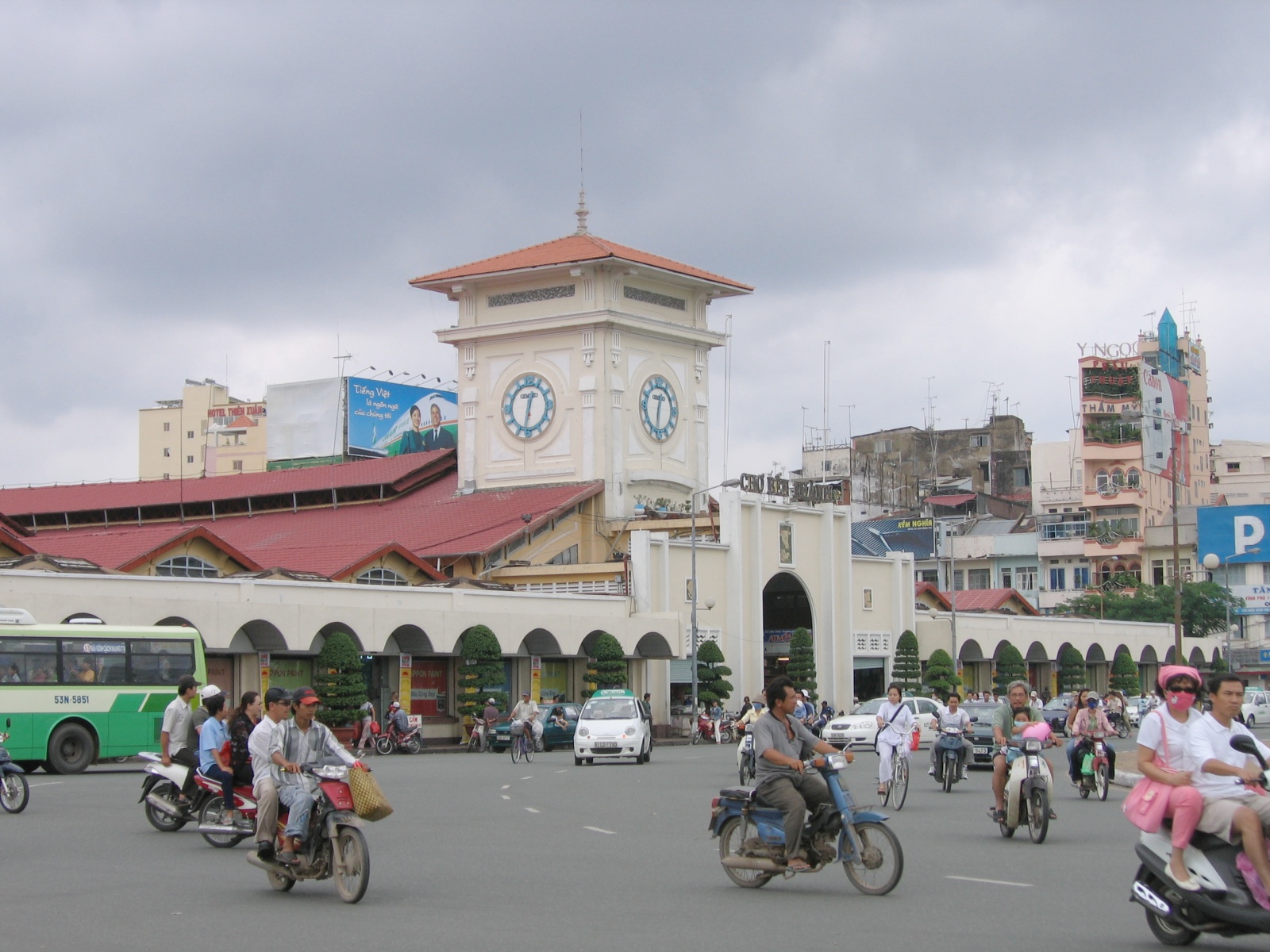
I took a walk around Saigon's tourist-oriented covered market today. It's a labyrinth of clothes, food, cloth, handicrafts and cheap souvenirs. If you're not careful, you will find yourself completely lost in the maze. On the outside, the south side of Ben Thanh Market is one of the iconic symbols of the city. The market has a scalloped, pink-ish façade that stretches the length of the whole block. The square clock tower is a fusion of architectural style, with its Eastern pagoda shape and Western ornamentation and detail. The image of the market was one of my first sights of Vietnam.

Ben Thanh is one of the older buildings in Saigon. The market used to be located along the Saigon River. The word bến means wharf, which means the place has always been associated with visitors who went there to shop. But the market is far from the river now. The stalls and shops were all moved to the present building in around 1912. The enormous building takes up the entire block. Under a roof of stadium proportions are row upon row of vendors and prepared food stalls, with a separate section for a small wet market. We tourists squeeze through the aisles. We're assaulted by friendly, insistent sales pitches. We're treated to a visual, aural, and olfactory smorgasborg. It's incredibly crowded, and I've been warned to look to my wallet and phone, for there's a reputation of pickpockets.

Chè - sweet soup
The prepared food is expensive by Saigon standards. Still, you'll get a plate of food and a drink for less than $2. Ordering a meal is a guessing game, because the menu that's offered is not necessarily available. And while you're trying to order, you will be assailed. Elderly beggars shake their gnarled arthritic hands for your change. Competing food stall workers shoo you away from their stalls to open up the space for more interested customers. And you'll find yourself seated on a barstool and squished against a plate barely wider than the ledge it's resting on. Passersby bump into your back as you eat. The food is good enough to eat. When you're done licking your plate clean, you might have room for dessert. So you mosey over to the chè stand, to choose from a chromatic variety of cold sweet soups.

Slicing pork
 
White, grape-sized eggplant
 
Garlic
 
Sharpening knives


Crabs
Beyond the prepared food is a specialized section of the larger market called the wet market. These markets, common around Asia, are so named because the floor is perpetually hosed down to wash toward the gutter the scraps of vegetable castings and offal, the drippings of animal blood, and the overrun from bubbling tanks full of live prawns, catfish, and ocean seafood. If you wear flip-flops, consider yourself warned--you will carry some of the floor's soupy wetness out on your toes. These markets are like a magnet that attracts locals in search of the freshest ingredients for their home-cooked dishes. The difference between the wet market in Ben Thahn and the ones in more remote areas is the lack of live birds and mammals that are slaughtered and dressed upon sale. I guess the absence has something to do with avoiding a spectacle for the tourists.

Dried fish, with coffee to the left
There's enough of a spectacle for the tourists back inside the main part of the market. So I walk back in. From a short stool beneath a mountain of woolen bolts, a young bald man with white spectacles offers to sew me a suit in a day. I walk by the dried and fermented foods, with wall-high stockpiles of pickled vegetables and salted fish parts. At the end of the aisle is a coffee vendor, who offers whiffs of black roasted beans. But the scent of dried fish is overwhelming. I imagine it's hard to sell coffee when it carries the briny scent of dried and fermented fish.

Suddenly, I realize in dismay that I've just entered the t-shirt section. This is the worst place to be when you're a foreigner who is neither shopping nor wants to be hassled. You'd have easier time getting past a hundred smarmy salesmen in a used car lot. Vendors, acclimated to the intimate personal space rules of their usual western clients, feel no taboo with grabbing a tourist as he or she floats by. One tenacious clerk snatches me by the elbow, smirks, and will not let go. I smile broadly and pretended not to speak English, but she will not let go. I tug on my arm. She will not let go. I let slip a miserable groan, and she releases her grip, and I skedaddle.

Snake wine
Wood-carved souvenirs


Shell cutlery
I run away from the t-shirts, into the clear, and feel like I can breathe again. Now I'm among hoodie sweatshirts, coats, and jackets. These are for tourists to bring back to cold weather climates, or for the Saigon girls riding around on bikes or scooters in the tan-inducing sun. I pass elaborate bone chopsticks, painted lacquerware, handwoven baskets, horn combs and bracelets, shell cutlery, majong and xiangqi games. I see a large woman pointing excitedly at a pile of coasters, and catch phrases of her Eastern European accent as she engages in intense bargaining. I see a Vietnamese vendor push a teenage boy, probably her nephew, off his footstool and onto the ground, where she sits on him until he squeals for mercy.

I grin, turn a corner, and freeze. I realize, again to my dismay, that I've fallen victim to Ben Thanh Market's greatest trick. I have lost my bearings and backtracked. Worst of all, I've inadvertently returned to the t-shirt section. A guy selling knock-off brands and Vietnam soundbites says, oh, you, again?! Here we go...

Sunday, July 10, 2011

นวดแผนโบราณ - Thai Massage

I wanted a massage. What I got was my body tied up into a pretzel and twisted until everything cracked. Such is the essence of Thai massage. The masseuse, an expert in physiology, subjects your body to heavy pressure on muscle groups, extreme stretches, and the satisfying snap of sinovial fluid as your joints are pulled to the point of popping.

The best reason to get a Thai massage in Thailand is the price. At home, a real Thai massage in a spa starts at around 45 dollars an hour, but can run in the hundreds. Granted, the cost of a ticket to Thailand will substantially offset your savings at the masseuse. But if you happen to be in the neighborhood, you can get a whole bunch of back-crackingly fine massages for pennies to the dollar. In Bankok's tourist district, an hour massage sets you back about six bucks. On Pranang Cape, a touristy place with relatively inflated prices, my family and I all got worked over for a little more than eight dollars. Tonight, on our last night in Thailand, each of us has an hour scheduled for less than the price of a pizza.

Labor in Thailand is cheap, and that pushes massage prices down. Mike says the minimum wage here is five dollars. Not per hour; per day. Low income explains why massage prices are rock bottom. The masseuse makes more in an hour than minimum wage earners get in a day. The funny thing is, a human being with a specialized skill takes in less money for an hour's hard work than the fish at the fish spa for the same amount of time. Sitting with your feet submerged in a tank in which tiny river fish nibble the dead skin off of feet costs twice as much as a highly-trained masseuse. The fish make more money than the people.

This will be our fourth massage in Thailand, but only my second Thai-style. I chose an oil massage the first time, and I chose poorly. I received a light smear of scented oil, rubbed on gently like I was a chicken getting basted for the oven. However, the last minute of the massage was worth the money. The lady sat me upright and crosslegged, folded my hands over my head and put me in a full-nelson headlock. She locked her right leg around my body and twisted me to the left, and half my spine went pop-pop-pop. Then, she switched legs and twisted me the other way, and the other half of my back cracked too. That was real Thai massage.

For a real Thai massage, the masseuse uses the whole body, not just the hands, to work out your kinks. The hard ridge of the forearms, the sharp points of the elbows, the knuckles and fingertips, and even the feet, are all employed in giving you a workover from the top of your head to the tips of your toes. You're fully clothed the whole time, and the masseuse puts you in various positions that are kind if like yoga. The second massage I got was a head and shoulders only job on the beach. Although I didn't get any of the cracking of joints typical of the full Thai package, the lady worked the deep tissue in circles, working out all the knots, and it was divine. Last night we went to the parlor at the east end of Pranang Cape, took adjacent mats on the floor, and enjoyed an hour of sensational bliss from top to bottom. And tonight, I have to say, I'm quite looking forward to being tied up and twisted on my last night in Thailand.

Saturday, July 2, 2011

Sen - The Lotus

The Trojan War hero Odysseus sailed his army home to Ithaca when vicious north winds sent by Poseidon blew his ship off course, out to sea, and far from home. The hapless ship floated for nine days, and may have drifted forever if they hadn't landed on an island off the coast of Northern Africa. On the island lived a people who ate a food made from the flowers of the lotus. These wave-weary warriors were welcomed by the peaceful people, and were fed the lotus that made them immediately forget all desire to return home. If it hadn't been for the integrity of Odysseus, who dragged his men to the ship, locked them to their oars, and led them back to the sea toward Greece, than Homer would've told a shorter, somewhat less-epic story.

Homer's seminal work is a double-edged trimming shears for the poor lotus. On one hand, the plant is praised for providing some sort of scrumptious sustenance--a real rib-sticker. On the other hand, the innocent flower is portrayed as a demon of apathy, lulling the eater into losing all sense of responsibility and desire. Not only does this portrayal give the lotus an unfair shake, we're not even sure which lotus these Greeks were munching on with their gyros and dolmas. There are many dozens of plants in the genus Lotus, a type of terrestrial legume. Some other plants with the name lotus aren't lotuses at all, but are actually waterlilies. Yet all are much maligned by their nominal association with the plant from Homer's epic yarn.

Lotus by Julien DerouxThe Vietnamese word for lotus is sen.
There's a plant called lotus that perfectly fits the description for the story in one esteemed respect--tasty cuisine. The Indian lotus does more than just sit and look pretty. Its roots, seeds, flowers, and leaves are all delicious. Steep tea from the petals, leaves, and stamens. Eat the seeds raw, pop them in a pan like popcorn, boil them in a fruit tea, or mash them up and stuff the paste into mochi or pastry. Peel the roots, slice them thin, and boil them in chicken broth until tender; serve with rice. Or pickle them, then slice, toss with herbs, cooked shrimp, shredded pickled carrots and daikon, and dress with fish sauce, peanuts and fried shallots. Tie it all up in a lotus leaf for convenient packaging, then unwrap, and you have your own plate--environmentally friendly, too.

Taipei Botanical GardenThe Taipei Botanical Garden
Perhaps another grace that might save the Indian lotus from being implicated as the lotus in the Odyssey is the fact that the Indian lotus is not a lotus at all, technically. Real lotuses are legumes, a.k.a. bean plants. And it's not a waterlily either, but it's very similar. The lotus grows in the same kind of soil as the lily: mud. Please excuse the rather non-technical term. This mud, as messy as it sounds, contributes to one of the most important aspects of the lotus. Many cultures place deep symbolic meaning on the unspoiled splendor that rises from its inauspicious bed of muck. The Hindus associate the lotus with their most divine gods. The Buddhists equate the elegant lotus with Buddha, who himself became enlightened beneath a tree on the muddy shores of a river. From mud, the lotus blooms. Out of the crude, perfection.

Our Lotus PondOur lotus pond
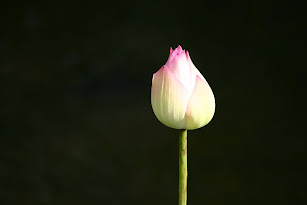
On our patio, we have a lotus plant. It lives in a five gallon clay pot brimming with mud, water, and flecks of floating yellow-green duckweed. Eight rigid stalks, the color of emerald, rise above the water to chest height. Each stalk terminates in a single broad leaf like an elephant's ear. All stalks begin underwater, all curled up like a rolled tongue. They pierce the surface of the water and rise at a rate of nearly half a foot a day. So too does the teardrop shaped bud, which unfolds into a bloom with a canary yellow seed cup tucked away among the petals. From the time they emerge from the water, the lotus flowers grow to full height of five feet, blossom, and drop all their petals within 10 days, leaving only the stem and iconic seed cup. The petals are so heavy and full of body that you can hear them hit the ground when they drop from the flower.

Our lotus bears white flowers. The pure white lotus is the national flower of India; for Vietnam, it's the pink. The pink ones can be found in gardens and fountains all over the place in Saigon. Lữ says it's hard to find a white lotus plant here. The person who sold it to her must have thought it was pink--otherwise it would have cost much more. Of course, expense is a relative term. A bouquet of ten lotuses, cut in 30-inch long stems and wrapped in its own leaf, costs less than two dollars. Taken home, trimmed, and placed in a vase with water, they bloom overnight. And if you nuzzle your nose between the petals for a sniff, you'll find a spicy-sweet, tropical flavor. To me, it's faintly reminiscent of anise, which Mike confirmed in a blind sniff test. Lữ is not sold on the comparison, and prefers to describe them as having a fresh, green scent, which I also find to be true.

Our bouquet is already falling apart. With every pass of the oscillating fan, another white petal drops to the ground with a heavy tap. Like so many things in life, lotus blossoms do not last long. Soon after they bloom, they are gone, leaving you with a lovely memory and all of its trappings, like appreciation, wonder, and loss. Perhaps that's the reason why the lotus is a symbol for non-attachment. It invites us to admire its growth, appreciate its unstained beauty, watch it fade, and let it go. Although the lotus-eaters in Odysseus's story lost their desire to return home, they were still attached. They lusted for their lotus food. So, obviously, it was not the sacred lotus. And besides, I seem to remember the lotus in the story was a tree.

Friday, July 1, 2011

Happy 5th, 8th and 4th Lunar Month!

Moon Phase
Today is a new moon. It also happens to be the fifth new moon after Tết, the Vietnamese New Year, which means today's moon marks the beginning of the fifth month in the Vietnamese lunar calendar. This calendar is one of many lunar calendar systems around the world. Southeast Asia alone has at least four different types, giving us a clue about the region's broad cultural diversity.

Guava FlowerIn the Chinese Calendar, this new moon begins the month of the guava blossom.
Historically, the Vietnamese calendar was based on the astronomical observations in Beijing that dictate the Chinese lunar calendar. Therefore, both calendars always began on the same day, which is the first new moon of spring. However, Vietnam changed time zones in the 1960's. Since then, the two calendars still begin on the same day, except for once every twenty-three years or so. The next time these two calendars won't be aligned is in 2030.

Both the Vietnamese and the Chinese calendars are based on seasonal change, in which the beginning of the year marks the decline of winter and the rise of spring. In contrast to the seasonal approach, some other lunar calendars of Southeast Asia are based on the position of the sun in relationship to the stars--or more precisely, on the twelve constellations that are recognized in the west.

Buddhist Wheel
Nations with large populations of Buddhists follow the Buddhist lunar calendar. This includes Sri Lanka, as well as Thailand, Burma, Cambodia and Laos. These last three countries follow a special version of the calendar that originated in Thailand. The Thai lunar calendar usually begins in December. However, the first month of the Thai lunar calendar doesn't signify the beginning of the year. Actually, the Thais follow three calendars, including the international calendar and their own solar calendar, which must make a challenge of asking someone's birthday. The months of the Thai lunar calendar are in sync with the new moon, so it seems today's new moon is the beginning of the Thai calendar's eighth month.

Hindu Swastika
Similar to the Buddhist calendar is the one used by the Hindus. At one point, all of Southeast Asia was once part of a great expansive Hindu civilization. Its lasting legacy is a religion that is still very common in the region. The Hindu New Years celebration in Singapore is called Ugadi. Last year, I got the chance to walk around Singapore's Little India during Ugadi. It was phenomenal. I have strong memories of brilliant lights, fragrant food, and wild music. Ugadi fell on April 4th of this year, which was the day after the new moon on April 3rd. Since Ugadi was three months ago, tomorrow marks the beginning of the fourth month.

Crescent and Star
Actually, the star-based calendars of the Buddhists and Hindus, and both the seasonal calendar of the Vietnamese and Chinese, are based on the time of the solar year, and therefore are not true lunar calendars. Technically, they're lunisolar. The only true lunar calendar is the Muslim calendar, which is also commonly used throughout Southeast Asia, especially in Malaysia and Indonesia, where the majority of the population is Muslim. And unlike the other calendars, the first day of the lunar month begins upon the first sight of the waxing crescent moon. That will be July 2, and marks the beginning of the eighth month of the Muslim calendar.

So, happy new moon, happy 5th month in the Chinese and Vietnamese lunar calendars, happy 8th month in the Buddhist and Muslim calendars, happy 4th month in the Hindu lunar calendar, and happy July, too!