It's good to be back in Saigon. Back to urban hiking, rooftop lounging, and teaching guitar. But I feel a little sad leaving Thailand. It was especially hard to leave behind the the exotic, heavenly world of Phra Nang Cape. Every day was straight out of a Jimmy Buffet song. We were treated to a week of unseasonably blue skies and starry nights. We carried home unforgettable memories of paradise. The alien calls of tropical birds around dawn that reverberate from everywhere deep in the lush trees. The lazy morning sun that took hours to crawl up over the jungle-capped karsts. The one-minute stroll down the path to the white sandy beach and mirror flat emerald-blue Andaman Sea. The long-tail boat taxis waiting in the surf that are the only access this landlocked peninsula on the southwest side of Thailand.
We spent the day lazing in the shade of a craggy karst on the southern beach, beneath rock climbers and tricksy crab-eating macaques. Sun-drunk and weary, we stumbled back to our bungalow and treated ourselves to an extraordinary meal for our last evening on the cape. A local chef dropped by carrying a rice bag brimming with shrimp, dried catfish, pomelo, basil, lemongrass, mushrooms, shredded coconut, peanuts, limes, and those ubiquitous firey Thai chilis, to whip us up authentic home cooking. A tiny woman with gold rimmed glasses and a heavy hand with the spice, she fixed up mountainous dishes of basil fried chicken, pomelo salad, fried catfish with shredded green papaya, and salty-sour tom yum soup. We feasted until filled to the gills, and still had enough left over for breakfast. With full bellies, we moseyed over for a Thai massage and ice cream before tucking into bed under a bright half moon.
I woke up before dawn, sat up under the white mosquito net that shrouded my bed, and listened to the jungle orchestra for the last time. Lữ was the next to stir, then Mike, who rallied me for a scramble up a nearby karst to check out the view, and then down into the valley to find the lagoon we had heard about in the guide books.
Red, mud-stained handropes snaked down the vertical path up the pitted limestone karst. The spectacular vista at the top revealed both coasts of the peninsula cradled between mountains and sea. Getting to the lagoon meant a short rappel down a wall into a muddy canyon littered with fallen trees and flittering butterflies. It looked straight out of a scene from Jurassic Park--specifically, one of the chase scenes where there's no where to run but forward. I imagined a herd of raging triceratops trampling through the canyon behind me.
I pressed on, and descended to bank of the lagoon. The space had craggy stalactite walls and clear water, with vines, moss, and indirect morning light that cascaded down from the rim. It was still and quiet, like a stone cathedral, except for a moment when a lone hornbill clucked and crashed through the thick palm leaf canopy. Shortly after 7 a.m., I made the climb back out, up from the lagoon and down the steep slope to the base of the karst. Around the bend, I caught a glimpse of a kingfisher with its broad, knife-like bill, before it darted into a clump of mangroves.
Back at the bungalow, we four packed up, breakfasted on our leftover feast, and marched down the path and into to the sea to board a long-tail boat to Ao Nang. The propeller kicked up a rooster tail behind us as we sped off into the waves, past sheer iron-red cliffs and impossible vertical islands, and up onto the beach where we had scheduled a van to meet us take us to the airport in Krabi.
Our van, like most touring vans in Asia, was outfitted a television and a karaoke-ready DVD player. But you'll have to bring your own microphone, since the ones in the vans are hidden by the drivers for the sake of their ears and sanity. Only once did I have the fortune to travel in karaoke style. In Taiwan, we took a weekend excursion with our class around to Hualien county on the East coast. Our bus had a karaoke machine with a wide selection of western songs. We sang until we ran out of tunes we knew, so we sang them all again.
The time between the Krabi airport and Bangkok flew by, with me passed out upright in the seat, head-back and mouth-agape before we even hit the air. We touched down and were shuttled off to a hotel, where a woman in a lilac colored dress, sitting at a lilac desk in front of a lilac wall, served us bottles of light, purple juice. We dropped off our things in our lilac-trimmed rooms and headed to the light rail bound for the weekend market in the city.
The market is overwhelmingly humongous. We had dropped in on it for about an hour on the day we left for Phra Nang Cape, but we never even scratched the surface. It can take a good twenty minutes to walk from one side to the other. The fact that people usually walk a mile in about twenty minutes should give you an idea of the enormousness of the thing. Inside the long dark corridors you'll find stacks of silk, Thai handicrafts, housewear, artisan pieces and antiques, cages of sugar gliders and other pets, and all kinds of clothing both original and knock-off varieties. Not to mention the stalls upon stalls upon stalls of food.
At the end of an evening of browsing just a fraction of the thousands of stalls, the rain began to fall. We ducked beneath a tarp, out of the rain, and tucked into a noodle stall for some stir fried wide noodles and fried rice. We grabbed a table beneath a glaring lightbulb dangling by its cord from the tarp overhead. The rainwater flowed down from the pitched tarp and collected at the edge before it could run off. The pocket of water swelled like a distended belly above the noodle cart, sending the owners into a tizzy trying to prevent the water from dumping onto their business. To add to their misery, rainwater dripped through the ridgeline of the tarp and down the central post covered in electric boxes and outlets. We watched anxiously as the cart owners stood in the flowing water and cautiously tugged rice cooker and light cords out of the sockets. When we finally got a break in the rain, we headed out into the freshly washed street and made for the subway.
We got back to the lilac colored hotel where we had scheduled our final Thai massage. After a blissful hour of having our muscles kneaded and joints yanked, Mike and I were ready to call it quits and get a good six hours of shut-eye before we had to set out for our flight back home. Lữ would have none of our nocturnal lazing about. She bounced into the room like Tigger to rally us up and out the door for happy hour between 2 and 4 a.m. at a notorious tourist magnet called Khaosan Road. But getting there wasn't going to be easy.
I've had bad taxi experiences before in Malaysia and Singapore. I hate to acknowledge the fact, but the physical clues that broadcast "I'm not a local" seem to also broadcast the message "Rip me off!" When I was in Malaysia, I watched my friends flag down a taxi, talk to the driver through the front door, then slam the door and flag down another taxi. Apparently, some of the Malaysian drivers will refuse to run the meter, in spite of signs that guarantee metered fares. The cheat comes when the drivers pretend to start the meter, drive you to your destination, then charge you 2 to 3 times what the meter would have run.
Refusing to run the meter is one scam. The roundabout route is another. In Singapore, a couple of us backpackers hired a taxi to take us to the nearby light rail station. Our driver started the meter. When we got to the station, instead of pulling over, the driver turned left, passed the station and took a right. We passed by other taxis letting out their passengers at the curb. I said to the driver, "here is good. Stop here please." But he behaved as if he didn't understand English and took another right behind the station. I pointed at the station, "no, we want to go there." He kept driving, took another right, and finally pulled over when we had taken a complete lap around the station. We had passed several taxi stands and dropoff points, and racked up an extra ten Singapore dollars on the meter. I was furious, paid the metered fare, and walked away without paying a tip.
Several times in Bangkok, we ran into taxis that refused to start the meter. As we left the lilac hotel bound for Khaosan Road, we hopped in a taxi--one of the pink ones that are supposedly well regulated. But the driver didn't start the meter. Mike used his authoritative voice, "use the meter." The driver said no. We all agreed to get out, and at the corner, when the cab stopped, I opened the door. The driver said, ok, ok, ok. Mike said, "meter?" The driver said ok. I shut my door, the taxi pulled out, but the meter wasn't running. Mike pointed directly at the dead box on the dashboard and said "you said you'd use the meter." The driver said "ok" again. And at the next corner, we all bailed. We flagged down two more taxis before we got one that would use the meter, which he used only after negotiation. We finally got into our metered taxi, and sped off into the night.
Our driver, a youngish guy with a ponytail and a scraggly mustache and goatee, blasted music and drove like he was on cocaine. He ground the gears and accelerated hard. To stop, he pulled the emergency handbrake. We almost hit a scooter, with its two unhelmeted riders. And we nearly slammed into a moving bus. In the back seat there were no seatbelts, and we seriously thought we'd never make it to Khaosan. But we did, and when we got there, there was a bumper to bumper line of cars. Our insane driver pulled into the oncoming traffic lane, tore past traffic and stumbly drunk pedestrians, and swerved back into the road within several yards of a head-on collision. The taxi pulled over to the curb. We were still alive. The meter was 100 Baht less than the guy would have charged us. Grateful to be among the living, we gave him a 55 Baht tip, and got the hell out of that car as fast as we could.
Khaosan at night is a lot like the backpacker district in Saigon. It's a party scene, and around midnight, the place is a cacophony of trance musics emanating from gaudy clubs, food and beer hawkers every few steps, and hordes of tacky locals and drunken tourists. There we were, on a quest for a bar, pushing through the multiculture crowd and hungering for the tasty objects peddled from the carts: pineapples the size of softballs and sweet as sugar, roasted bananas, heaping styrofoam plates of perfectly seasoned pad thai noodles for less than a dollar.
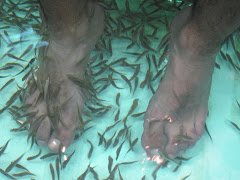
But first, we dropped into a fish spa, where we indulged in our second "massage" treatment of the night. We sat on the edge of a massive aquarium, plunged our legs into the water up to our knees, and offered up our feet to fish that feed on the dead skin. The procedure is painless. But I felt like an unbearably ticklish current of electricity had formed a cloud around my toes, soles and ankles. And that's just the physical sensation. Add the ick factor of being superficially eaten alive by fish, and you realize that you are probably in the middle of the strangest activity you've ever done. For about $66, you can have the ultimate treatment--completely submerged--a full body, all-you-can-eat buffet for the fish.
We pulled our feet from the tanks just as a pack of lightly toasted Europeans plunged theirs in. The fish had not yet filled themselves with dead skin, and went to work, sending our replacements into fits. We walked out of the fish spa, and the sound of squeals faded as we were pulled into the current of Khaosan's revelers. It was not yet 3:30 a.m. A circle had formed around a troupe of young breakdancers. They danced to the music coming out of one of the nearby clubs. Aerial feats defied gravity and physiology. Intense acrobatics drew more and more people into the crowd, which filled up the street and made hard crossing for taxis and tuk-tuks. Anytime one of the small auto rickshaws found a gap in the crowd to pass through, one of the dancers took the passing cart as an opportunity to show off crazy horizontal skills.
We still hadn't found the bar that was the reason we left our lilac colored hotel. With only a few more minutes left of happy hour, we decided it was time to give up and head home, when we spotted the bar's sign overhead. We headed in. The girls ordered pints of Thailand's most popular domestic beer. Mike ordered a pint of the black stuff. I instructed the bartender how to make a shandy for myself, and we all settled down for an hour. Our thirsts slaked, we headed to the street and searched for a taxi that wouldn't try to scam us. With luck we found one immediately, who shuttled us across Bangkok, drowsy and dozing all the while.
With no sleep, we packed our bags, checked out of our lilac hotel, and arrived at the Bangkok International Airport to board our flight home. We returned to Saigon by 9 a.m. on Sunday. I spent the next two days catching up on sleep missed on Saturday night. As good as it is to be home, our homecoming had a hint that is slightly bittersweet. We padded around barefoot in the bungalow, just like back in the states, and I have to get used to wearing houseslippers again. And I have to fall asleep without the sound of the ocean, like cyclical breathing, just a few hundred yards out the window. And... there are no coconut trees either.
Showing posts with label Thailand. Show all posts
Monday, July 11, 2011
Sunday, July 10, 2011
นวดแผนโบราณ - Thai Massage
I wanted a massage. What I got was my body tied up into a pretzel and twisted until everything cracked. Such is the essence of Thai massage. The masseuse, an expert in physiology, subjects your body to heavy pressure on muscle groups, extreme stretches, and the satisfying snap of sinovial fluid as your joints are pulled to the point of popping.
The best reason to get a Thai massage in Thailand is the price. At home, a real Thai massage in a spa starts at around 45 dollars an hour, but can run in the hundreds. Granted, the cost of a ticket to Thailand will substantially offset your savings at the masseuse. But if you happen to be in the neighborhood, you can get a whole bunch of back-crackingly fine massages for pennies to the dollar. In Bankok's tourist district, an hour massage sets you back about six bucks. On Pranang Cape, a touristy place with relatively inflated prices, my family and I all got worked over for a little more than eight dollars. Tonight, on our last night in Thailand, each of us has an hour scheduled for less than the price of a pizza.
Labor in Thailand is cheap, and that pushes massage prices down. Mike says the minimum wage here is five dollars. Not per hour; per day. Low income explains why massage prices are rock bottom. The masseuse makes more in an hour than minimum wage earners get in a day. The funny thing is, a human being with a specialized skill takes in less money for an hour's hard work than the fish at the fish spa for the same amount of time. Sitting with your feet submerged in a tank in which tiny river fish nibble the dead skin off of feet costs twice as much as a highly-trained masseuse. The fish make more money than the people.
This will be our fourth massage in Thailand, but only my second Thai-style. I chose an oil massage the first time, and I chose poorly. I received a light smear of scented oil, rubbed on gently like I was a chicken getting basted for the oven. However, the last minute of the massage was worth the money. The lady sat me upright and crosslegged, folded my hands over my head and put me in a full-nelson headlock. She locked her right leg around my body and twisted me to the left, and half my spine went pop-pop-pop. Then, she switched legs and twisted me the other way, and the other half of my back cracked too. That was real Thai massage.
For a real Thai massage, the masseuse uses the whole body, not just the hands, to work out your kinks. The hard ridge of the forearms, the sharp points of the elbows, the knuckles and fingertips, and even the feet, are all employed in giving you a workover from the top of your head to the tips of your toes. You're fully clothed the whole time, and the masseuse puts you in various positions that are kind if like yoga. The second massage I got was a head and shoulders only job on the beach. Although I didn't get any of the cracking of joints typical of the full Thai package, the lady worked the deep tissue in circles, working out all the knots, and it was divine. Last night we went to the parlor at the east end of Pranang Cape, took adjacent mats on the floor, and enjoyed an hour of sensational bliss from top to bottom. And tonight, I have to say, I'm quite looking forward to being tied up and twisted on my last night in Thailand.
The best reason to get a Thai massage in Thailand is the price. At home, a real Thai massage in a spa starts at around 45 dollars an hour, but can run in the hundreds. Granted, the cost of a ticket to Thailand will substantially offset your savings at the masseuse. But if you happen to be in the neighborhood, you can get a whole bunch of back-crackingly fine massages for pennies to the dollar. In Bankok's tourist district, an hour massage sets you back about six bucks. On Pranang Cape, a touristy place with relatively inflated prices, my family and I all got worked over for a little more than eight dollars. Tonight, on our last night in Thailand, each of us has an hour scheduled for less than the price of a pizza.
Labor in Thailand is cheap, and that pushes massage prices down. Mike says the minimum wage here is five dollars. Not per hour; per day. Low income explains why massage prices are rock bottom. The masseuse makes more in an hour than minimum wage earners get in a day. The funny thing is, a human being with a specialized skill takes in less money for an hour's hard work than the fish at the fish spa for the same amount of time. Sitting with your feet submerged in a tank in which tiny river fish nibble the dead skin off of feet costs twice as much as a highly-trained masseuse. The fish make more money than the people.
This will be our fourth massage in Thailand, but only my second Thai-style. I chose an oil massage the first time, and I chose poorly. I received a light smear of scented oil, rubbed on gently like I was a chicken getting basted for the oven. However, the last minute of the massage was worth the money. The lady sat me upright and crosslegged, folded my hands over my head and put me in a full-nelson headlock. She locked her right leg around my body and twisted me to the left, and half my spine went pop-pop-pop. Then, she switched legs and twisted me the other way, and the other half of my back cracked too. That was real Thai massage.
For a real Thai massage, the masseuse uses the whole body, not just the hands, to work out your kinks. The hard ridge of the forearms, the sharp points of the elbows, the knuckles and fingertips, and even the feet, are all employed in giving you a workover from the top of your head to the tips of your toes. You're fully clothed the whole time, and the masseuse puts you in various positions that are kind if like yoga. The second massage I got was a head and shoulders only job on the beach. Although I didn't get any of the cracking of joints typical of the full Thai package, the lady worked the deep tissue in circles, working out all the knots, and it was divine. Last night we went to the parlor at the east end of Pranang Cape, took adjacent mats on the floor, and enjoyed an hour of sensational bliss from top to bottom. And tonight, I have to say, I'm quite looking forward to being tied up and twisted on my last night in Thailand.
Friday, July 8, 2011
ชาเย็น - Thai Tea
Wherever I go in the world, I turn to beverage carts and food stalls to see the drink menu. The finds have been spectacular. In Taiwan, they cook wintermelon into an earthy, cooling, and refreshing drink. And their iced milk tea is to die for. It's light and fragrant--the classic medium for boba tapioca pearls. Hong Kong has it's own special milk tea, a powerfully concentrated brew made from a blend of black teas to which evaporated milk is added. It's reddish orange, served hot or iced, and its intense flavor is a Hong Kong specialty. Singapore hawker centers serve bandung, an iced milky pink drink flavored with rosewater. But the beverage of choice is a black iced coffee called kopi bing. Invariably served in a glass mug, this drink is named with the Malay word for coffee and the Chinese word for ice as a reflection of Singapore's rich cultural heritage. Likewise, in Vietnam the coffee is preferred. Their intense, syrupy brew is poured over ice and stirred up to a red foamy froth, or has thick, honey-like condensed milk stirred in.
When I think of Thailand, I think of flavors from stateside Thai restaurants. Especially, I think of the orange, milky, spiced tea in a tall glass filled with ice, with a layer of evaporated milk floating on top. In my experience, it's the iconic Thai drink. But they say (whoever they are) that nothing in the states is ever like the original stuff that you get in the country where it comes from. So when I got here I made a mission to try real Thai iced tea. Little did I know, getting Thai tea in Thailand was going to be a tall order.
Here on Pranang Cape, I ordered ice tea at the first place we went to. The barista pulled a yellow box with a familiar label from the back of a shelf, opened it, and grabbed the same type of tea bag that I had in my kitchen at home. This was no Thai tea. I asked to forget the order, and we moved on. What was the problem? You didn't ask for milk tea, I was told. So I tried again, this time at a different restaurant. While a friend ordered Thai iced tea, I ordered milk tea. Neither of us got the stuff we know from home. Mine was that old familiar tea bag steeping in a cup of hot water with milk on the side. My friend's was the same thing, but poured over ice. A triple dead-end.
It wasn't until we traveled by sea and by land, to a common marketplace in the nearby town, when I finally found the tea I had been looking for. We hitched a boat into town sometime before dawn. The tide was low, and we walked across a hundred yards of mud flats to the edge of the water. Then, it was another fifty yards through the water to the wooden longboat. We climbed into the hull and watched with wet feet as the sun rose while we shuttled across the sea. We disembarked and hopped into the covered bed an old rusty pick-up truck. The chain link gate closed behind us, fencing us in completely like a cage, and I knew what a dog feels like when he gets caught by the dogcatcher.
We rode in the back of our pound paddywagon across the peninsula, past palm oil groves and resort villas, into town, and stopped in front of the village market. Our "dogcatcher" saw fit to let us out of the cage, and we headed into the market. It was extraordinary. Aisles upon aisles of fruits and vegetables. A veritable dry aquarium, with species of fish and shellfish too numerous to count. And oh so much meat. Since many of the southern Thai people are Muslim, the meat area is divided into Halal and non halal. So is the food center, where hawkers peddle packages and plates of endless variety, with giant pots of soups bubbling away, and neatly wrapped packages of sweet-sticky rice wrapped in leaves, and all sorts of things cooked on sticks. And things we could buy to eat and drink from these stalls delighted our tastebuds.
There, in one of the food stalls, we finally found it--a plastic pitcher with orange, milky tea, which was so thick it clung to the sides. Immediately we ordered enough to go around. The man filled the plastic cups with ice, then tea, then floated condensed milk on top for that extra milky kick. He capped them with lids and straws, and handed them over in exchange for 66 cents each. On the first taste, we found out something extraordinary. The Thai tea in the states is just as good as the original. Beverage heaven.
The moral of the story is sometimes they can be wrong about the stuff at home. The international food we get can be as good as the original. And when you go to the country of origin in search of the original flavor, I have one piece of advice: avoid resorts, because they work hard to provide you with the tastes you know from home. And that, in my opinion, is no way to travel.
When I think of Thailand, I think of flavors from stateside Thai restaurants. Especially, I think of the orange, milky, spiced tea in a tall glass filled with ice, with a layer of evaporated milk floating on top. In my experience, it's the iconic Thai drink. But they say (whoever they are) that nothing in the states is ever like the original stuff that you get in the country where it comes from. So when I got here I made a mission to try real Thai iced tea. Little did I know, getting Thai tea in Thailand was going to be a tall order.
Here on Pranang Cape, I ordered ice tea at the first place we went to. The barista pulled a yellow box with a familiar label from the back of a shelf, opened it, and grabbed the same type of tea bag that I had in my kitchen at home. This was no Thai tea. I asked to forget the order, and we moved on. What was the problem? You didn't ask for milk tea, I was told. So I tried again, this time at a different restaurant. While a friend ordered Thai iced tea, I ordered milk tea. Neither of us got the stuff we know from home. Mine was that old familiar tea bag steeping in a cup of hot water with milk on the side. My friend's was the same thing, but poured over ice. A triple dead-end.
It wasn't until we traveled by sea and by land, to a common marketplace in the nearby town, when I finally found the tea I had been looking for. We hitched a boat into town sometime before dawn. The tide was low, and we walked across a hundred yards of mud flats to the edge of the water. Then, it was another fifty yards through the water to the wooden longboat. We climbed into the hull and watched with wet feet as the sun rose while we shuttled across the sea. We disembarked and hopped into the covered bed an old rusty pick-up truck. The chain link gate closed behind us, fencing us in completely like a cage, and I knew what a dog feels like when he gets caught by the dogcatcher.
We rode in the back of our pound paddywagon across the peninsula, past palm oil groves and resort villas, into town, and stopped in front of the village market. Our "dogcatcher" saw fit to let us out of the cage, and we headed into the market. It was extraordinary. Aisles upon aisles of fruits and vegetables. A veritable dry aquarium, with species of fish and shellfish too numerous to count. And oh so much meat. Since many of the southern Thai people are Muslim, the meat area is divided into Halal and non halal. So is the food center, where hawkers peddle packages and plates of endless variety, with giant pots of soups bubbling away, and neatly wrapped packages of sweet-sticky rice wrapped in leaves, and all sorts of things cooked on sticks. And things we could buy to eat and drink from these stalls delighted our tastebuds.
There, in one of the food stalls, we finally found it--a plastic pitcher with orange, milky tea, which was so thick it clung to the sides. Immediately we ordered enough to go around. The man filled the plastic cups with ice, then tea, then floated condensed milk on top for that extra milky kick. He capped them with lids and straws, and handed them over in exchange for 66 cents each. On the first taste, we found out something extraordinary. The Thai tea in the states is just as good as the original. Beverage heaven.
The moral of the story is sometimes they can be wrong about the stuff at home. The international food we get can be as good as the original. And when you go to the country of origin in search of the original flavor, I have one piece of advice: avoid resorts, because they work hard to provide you with the tastes you know from home. And that, in my opinion, is no way to travel.
มะพร้าว - Coconut
In my family, I have a reputation of being cuckoo for coconuts. Not the brown, monkey-faced cannonballs that contain insipid water and hard meat that is excellent for shredding into dried coconut flakes. I mean the young coconut with its sweet, tangy liquid and opaque jelly.
I got hooked on these husky fruits in Hawaii, on the east coast of Oahu, when a friend and I stumbled across a fallen branch with five or six coconuts. We had an hand axe along a desire to learn how to fend for ourselves if ever marooned on a deserted island. We cracked them open and discovered sugary juice within each leathery green fruit, as well as meat so tender you could scoop it out with your fingers. Since that trip, I've given up the axe in search of more efficient tools for getting to the goods. A machete is manly, but not too effective. In a desperate but hilarious moment, Kevin and I resorted to hurling coconuts against the corner of a curb--this method is satisfyingly primal, but resulted in not a bit of success. After coming home and buying green coconuts from the local store, I found the meat cleaver is best tool for the task.
While getting into the coconuts can be tricky, actually getting TO them is another story. What I thought was the old fashioned method involves climbing the tree yourself. I have been instructed on two sound methods. First is the monkey style, in which you tuck your knees into your chest and place your feet under your body, and the leverage keeps you on the tree. The other style is the frog, in which you place both feet on opposite sides of the palm trunk, and your body weight keeps you up.
I rather believe the style of frog to be most efficacious in the endeavor of coconut acquisition. The other day, I spied a coconut hanging from a short tree just a few hundred feet from our bungalow, and employed the frog style with all speed. I shimmied up the trunk and twisted the giant seed, which is not botanically a nut any more than a tomato is a vegetable. It broke free and plummeted to the ground far below (um...maybe 14 feet, but hey, I got it myself). With no meat cleaver, I employed a kitchen knife to the work of opening my harvest, and snicker-snack, poured forth the delicious water into an empty pot. With a spoon, I dug out the jelly, which had just begun to harden and turn white. The cost of my labor is a scratched up chest, right forearm, and left knee. Not a bad payoff, but the soreness has kept me out of trees for the past few days.
So, the frog style isn't the most ideal method for me to get the coconuts if I can only climb once before taking off a few days to heal. Next time, I'd like to try the tried and true method that the Thais use; they get a monkey to do it. In the southern Malay peninsula, coconut harvesters train pig-tailed macaques to scurry up the trees, differentiate the ripe coconuts from the unripe ones, and bite the stems in twain, letting the coconut drop 50 to 60 feet to the ground below. Clearly, I am no monkey.
According to this article, humans have used monkeys to gather fruits for millennia. Here in Thailand, monkeys actually go to coconut school, where they receive the training they need to be productive workers in the coconut industry. This means, in addition to learning how to cooperate with their handlers and gather good coconuts, they learn how to put rodent poison in the trees.
In this area, there are no pig-tailed macaques. Instead, there are macaques of the crab eating variety. I've never seen them eat a crab. They seem to hang out on the beaches and, with their cuteness, bribe the tourists into parting with their food in exchange for photos, or alternatively, aggressively scare the tourists into leaving said food behind as they flee. Also, here lives a species of gibbon, the world's smallest ape, and a type of langur, which is a black monkey with a white-moustachioed face. None of these primates has a taste for coconuts.
Instead, the local coconut afficionado is a squirrel that the ex-pats like to call roof rats. These tree toppers gnaw holes into coconuts while they're still hanging on the tree. I'm not sure what they do then; maybe they tip the coconuts over to spill the juice so they can get to the meat, a senseless waste of delicious juice in my opinion. But I can't talk these squirrels out of it, or into saving the juice for me. They just cling to their canopy branches and bark angrily--the first time I heard one barking, its voice was so low and throaty, I thought it was a primate. But it was just a squirrel, and judging by the vast number of discarded husks with gaping holes strewn about, I can tell I'm not the only one around here who is cuckoo for coconuts.
I got hooked on these husky fruits in Hawaii, on the east coast of Oahu, when a friend and I stumbled across a fallen branch with five or six coconuts. We had an hand axe along a desire to learn how to fend for ourselves if ever marooned on a deserted island. We cracked them open and discovered sugary juice within each leathery green fruit, as well as meat so tender you could scoop it out with your fingers. Since that trip, I've given up the axe in search of more efficient tools for getting to the goods. A machete is manly, but not too effective. In a desperate but hilarious moment, Kevin and I resorted to hurling coconuts against the corner of a curb--this method is satisfyingly primal, but resulted in not a bit of success. After coming home and buying green coconuts from the local store, I found the meat cleaver is best tool for the task.
While getting into the coconuts can be tricky, actually getting TO them is another story. What I thought was the old fashioned method involves climbing the tree yourself. I have been instructed on two sound methods. First is the monkey style, in which you tuck your knees into your chest and place your feet under your body, and the leverage keeps you on the tree. The other style is the frog, in which you place both feet on opposite sides of the palm trunk, and your body weight keeps you up.
I rather believe the style of frog to be most efficacious in the endeavor of coconut acquisition. The other day, I spied a coconut hanging from a short tree just a few hundred feet from our bungalow, and employed the frog style with all speed. I shimmied up the trunk and twisted the giant seed, which is not botanically a nut any more than a tomato is a vegetable. It broke free and plummeted to the ground far below (um...maybe 14 feet, but hey, I got it myself). With no meat cleaver, I employed a kitchen knife to the work of opening my harvest, and snicker-snack, poured forth the delicious water into an empty pot. With a spoon, I dug out the jelly, which had just begun to harden and turn white. The cost of my labor is a scratched up chest, right forearm, and left knee. Not a bad payoff, but the soreness has kept me out of trees for the past few days.
So, the frog style isn't the most ideal method for me to get the coconuts if I can only climb once before taking off a few days to heal. Next time, I'd like to try the tried and true method that the Thais use; they get a monkey to do it. In the southern Malay peninsula, coconut harvesters train pig-tailed macaques to scurry up the trees, differentiate the ripe coconuts from the unripe ones, and bite the stems in twain, letting the coconut drop 50 to 60 feet to the ground below. Clearly, I am no monkey.
According to this article, humans have used monkeys to gather fruits for millennia. Here in Thailand, monkeys actually go to coconut school, where they receive the training they need to be productive workers in the coconut industry. This means, in addition to learning how to cooperate with their handlers and gather good coconuts, they learn how to put rodent poison in the trees.
In this area, there are no pig-tailed macaques. Instead, there are macaques of the crab eating variety. I've never seen them eat a crab. They seem to hang out on the beaches and, with their cuteness, bribe the tourists into parting with their food in exchange for photos, or alternatively, aggressively scare the tourists into leaving said food behind as they flee. Also, here lives a species of gibbon, the world's smallest ape, and a type of langur, which is a black monkey with a white-moustachioed face. None of these primates has a taste for coconuts.
Instead, the local coconut afficionado is a squirrel that the ex-pats like to call roof rats. These tree toppers gnaw holes into coconuts while they're still hanging on the tree. I'm not sure what they do then; maybe they tip the coconuts over to spill the juice so they can get to the meat, a senseless waste of delicious juice in my opinion. But I can't talk these squirrels out of it, or into saving the juice for me. They just cling to their canopy branches and bark angrily--the first time I heard one barking, its voice was so low and throaty, I thought it was a primate. But it was just a squirrel, and judging by the vast number of discarded husks with gaping holes strewn about, I can tell I'm not the only one around here who is cuckoo for coconuts.
Wednesday, July 6, 2011
Amazing Thailand Facts
- 1. Thailand is a kingdom. Its government is a constitutional monarchy, and the royal ruler shares power with a democratically elected prime minister.
- 2. While maintaining a strong sense of its traditional culture, Thailand has embraced aspects of western culture by its own accord. Unlike nearly all of its neighbor countries, Thailand was never colonized by a European nation.
- 3. Thailand is the size of Texas, and is the length from Seattle to Los Angeles.
- 4. The falconet, a raptor that is indigenous to Thailand, catches dragonflies in mid-air.
- 5. The king cobra of Thailand can grow to a colossal length of 19 feet.
- 6. All Thailand nationals are considered to be Thai, whether they are ethnically Thai, Chinese, Malay, or any of a number of minority groups.
- 7. The King and I was based on the real life experiences of a governess to the king of Siam. Her name was Anna Leonowens, and her story was largely fabricated and sensationalized.
- 8. The depiction of Buddha in the reclining position presents the image of Siddartha at the moment he attained Nirvana.
- 9. Thais consider the head to be most sacred. To pat someone on the head is considered very rude. The feet are considered to be the lowest and dirtiest part of the body. The left hand is also considered to be unclean, and must never be used to eat, recieve gifts, or shake hands.
- 10. The Thai chili pepper, that ubiquitous firey spice that makes Thai food so characteristic, was introduced from the New World.
Monday, July 4, 2011
Trains, Buses, and Boats
Status Update
We wrapped up our sightseeing with a walk through the city back to our hotel to pick up our bags, then flagged down another hot pink taxi to take us to the train station. The cabbie was a boisterous fellow who told us that the Thai king was born in Boston. And Thailand was called Siam up until the 1940's. And there are two kinds of cats in Thailand: Siamese cats and Thai cats. He said Siamese cats are black and cream colored with blue eyes. And Thai cats are cats of every other kind. Then he chuckled to himself and asked if we would pay him more than the metered fare. Mike was happy to. The gregarious cabbie got an extra 15 baht.
Taking the overnight train was an experience. Twelve hours in a rackety-clackety wooden train car with open windows and rotating ceiling fans and no insulation from the sound of passing trains that hurtled by in the darkness and seemed to shake our car off its tracks. After we endured the overnight train trip, we added another six hours between the bus, the cart, and the boat. The mode of transportation was my suggestion,and I consider myself lucky that bro and sis didn't throttle me to death when we got off the train this morning at 5:15. But they took the high road with a positive outlook. The wooden, open-windowed, rattling train was an experience, Lữ said, and it was an experience she would avoid repeating.
One good thing about the train was the endless stream of foodcarts that passed through our car. They let up for only about three hours in the middle of the night. It was like one of those sushi bars with the carousel belt full of plates that constantly glide by you carrying something new and tasty to grab before it slips past. It was lovely. All night long, food peddlers hounded the passengers with bowls of chicken and rice soup, trays of omelettes, tins full of custard pudding with lotus seeds, and plates of fresh sliced mangoes with chili sugar, wax apples, and pineapple. But they'll charge an arm and a leg in the cafe car...just like everywhere else in the world. The veritable buffet was a welcome treat, but I'm afraid my traveling companions and I will suffer from train-lag for the next few days. Personally, I don't think I'd terribly mind if I fell asleep for a hour as soon as I laid down on a massage table, but I think bro and sis would consider it a waste of ten dollars. That's right. Ten. For an hour.
We finally made it to our bungalow on the narrow isthmus south of Pranang Cape. The place we're staying at is actually not called Krabi, like I'd said earlier, but Railey Beach. The west side of the isthmus is a gorgeous strip of white sand beach on the edge of an aquamarine bay, tucked in between towering vegetation-covered limestone cliffs. There are three species of primates that live here: macaques, gibbons, and langurs, the latter sings a chorus in the early morning hours, I'm given to understand. Can't wait.
1. Happy 4th of July! I had the pleasure of celebrating 12 hours ago, and you all still have the rest of the day. Enjoy!
2. Thailand just elected its first female prime minister ever.We went sightseeing in Bankok to check out the weekend market, the reclining Buddha statue at Wat Po, the Wat Phra Kaew Emerald Buddha, and the Grand Palace grounds, all within about five hours. We probably could have spent five hours at any one of those places. Fortunately we'll have a chance to make up some time in the places we passed through when we get back on Saturday.
We wrapped up our sightseeing with a walk through the city back to our hotel to pick up our bags, then flagged down another hot pink taxi to take us to the train station. The cabbie was a boisterous fellow who told us that the Thai king was born in Boston. And Thailand was called Siam up until the 1940's. And there are two kinds of cats in Thailand: Siamese cats and Thai cats. He said Siamese cats are black and cream colored with blue eyes. And Thai cats are cats of every other kind. Then he chuckled to himself and asked if we would pay him more than the metered fare. Mike was happy to. The gregarious cabbie got an extra 15 baht.
Taking the overnight train was an experience. Twelve hours in a rackety-clackety wooden train car with open windows and rotating ceiling fans and no insulation from the sound of passing trains that hurtled by in the darkness and seemed to shake our car off its tracks. After we endured the overnight train trip, we added another six hours between the bus, the cart, and the boat. The mode of transportation was my suggestion,and I consider myself lucky that bro and sis didn't throttle me to death when we got off the train this morning at 5:15. But they took the high road with a positive outlook. The wooden, open-windowed, rattling train was an experience, Lữ said, and it was an experience she would avoid repeating.
One good thing about the train was the endless stream of foodcarts that passed through our car. They let up for only about three hours in the middle of the night. It was like one of those sushi bars with the carousel belt full of plates that constantly glide by you carrying something new and tasty to grab before it slips past. It was lovely. All night long, food peddlers hounded the passengers with bowls of chicken and rice soup, trays of omelettes, tins full of custard pudding with lotus seeds, and plates of fresh sliced mangoes with chili sugar, wax apples, and pineapple. But they'll charge an arm and a leg in the cafe car...just like everywhere else in the world. The veritable buffet was a welcome treat, but I'm afraid my traveling companions and I will suffer from train-lag for the next few days. Personally, I don't think I'd terribly mind if I fell asleep for a hour as soon as I laid down on a massage table, but I think bro and sis would consider it a waste of ten dollars. That's right. Ten. For an hour.
We finally made it to our bungalow on the narrow isthmus south of Pranang Cape. The place we're staying at is actually not called Krabi, like I'd said earlier, but Railey Beach. The west side of the isthmus is a gorgeous strip of white sand beach on the edge of an aquamarine bay, tucked in between towering vegetation-covered limestone cliffs. There are three species of primates that live here: macaques, gibbons, and langurs, the latter sings a chorus in the early morning hours, I'm given to understand. Can't wait.
Sunday, July 3, 2011
The Capital of Thailand
Bankok. The plane touched down at dusk, and it was already dark by the time we got our pictures taken, our passports stamped, and our driverwho led us to a hot pink taxi with a 15-inch subwoofer in the trunk
and a gold statue of Buddha on the dashboard.
Driving on the interstate highway from the airport at night, you don't see much besides buildings, billboards, roadsigns and cars that drive opposite side of the road. Feels kind of like the states, in a way.Bankok has a lot of pickup trucks and SUV's. Thanks to the light
drizzle and the balmy heat, if you can pretend that the rows of billboards and roadsigns are in English, and not the beautiful Thai script, than you might feel like you're driving on an interstate around Miami or Jacksonville.
We stayed in a hotel in a sort of backpacker's district, with a money exchange booth, a tour package sales desk, and a tailor, just in case you want to get a suit, all conveniently located in the lobby downstairs.
When it was time to explore this neighborhood with its shuttered two-story shophouses, we stepped into the drizzly evening air to the smell
of grilled food and tropical rain. We passed by tarp covered t-shirt and souvenier shops, cheap massage and beauty parlors, gaudy theme
tiki bars, and hawker carts with all kinds of grilled goods, pad Thai noodles, and fresh cut pineapple, mango, and papaya. Pushy tuk tuk
drivers tried to wrangle us into their natural gas powered open cart taxis. But we had only one thing in mind: food. We found a night market on the far end of a park and tucked in.
After slurping down steamy bowls of beef soup with angel hair rice noodles, and curry soup with chicken, egg, and peanuts, we meandered over to a brilliant dessert cart with bowls filled with things all the color of a candy store. We spooned gobs of a flan-style custard cooked in a pumpkin squash, and pudding with sweet sticky rice, drenched in coconut cream, chased by a rich green milk tea. This place is a foodie's paradise.
We're off to see the weekend market and the imperial palace today. But I'm most looking forward to breakfast, lunch, dinner, and all the in-between meals. Then goodbye, Bankok, as we board a sleeper car on an overnight southbound train tonight, headed for a bungalow in a town called Krabi.
and a gold statue of Buddha on the dashboard.
Driving on the interstate highway from the airport at night, you don't see much besides buildings, billboards, roadsigns and cars that drive opposite side of the road. Feels kind of like the states, in a way.Bankok has a lot of pickup trucks and SUV's. Thanks to the light
drizzle and the balmy heat, if you can pretend that the rows of billboards and roadsigns are in English, and not the beautiful Thai script, than you might feel like you're driving on an interstate around Miami or Jacksonville.
We stayed in a hotel in a sort of backpacker's district, with a money exchange booth, a tour package sales desk, and a tailor, just in case you want to get a suit, all conveniently located in the lobby downstairs.
When it was time to explore this neighborhood with its shuttered two-story shophouses, we stepped into the drizzly evening air to the smell
of grilled food and tropical rain. We passed by tarp covered t-shirt and souvenier shops, cheap massage and beauty parlors, gaudy theme
tiki bars, and hawker carts with all kinds of grilled goods, pad Thai noodles, and fresh cut pineapple, mango, and papaya. Pushy tuk tuk
drivers tried to wrangle us into their natural gas powered open cart taxis. But we had only one thing in mind: food. We found a night market on the far end of a park and tucked in.
After slurping down steamy bowls of beef soup with angel hair rice noodles, and curry soup with chicken, egg, and peanuts, we meandered over to a brilliant dessert cart with bowls filled with things all the color of a candy store. We spooned gobs of a flan-style custard cooked in a pumpkin squash, and pudding with sweet sticky rice, drenched in coconut cream, chased by a rich green milk tea. This place is a foodie's paradise.
We're off to see the weekend market and the imperial palace today. But I'm most looking forward to breakfast, lunch, dinner, and all the in-between meals. Then goodbye, Bankok, as we board a sleeper car on an overnight southbound train tonight, headed for a bungalow in a town called Krabi.
Subscribe to:
Posts (Atom)


