Showing posts with label Saigon. Show all posts
Friday, August 26, 2011
Saigon Funnies
Saturday, August 13, 2011
Pl-ice-tic Skating
| Skating on synthetic ice is kind of... nice |
"Where else can you get bit by a mosquito when ice skating," Mike said, chuckling as he glided by me, a little wobblier than I'm used to seeing when he has skates laced to his feet, but skating nonetheless, on a giant sheet of white, slippery plastic.
We checked out the synthetic ice skating rink, on the third floor (what we would call the fourth floor) of the public sports and rec complex near our apartment. The rink is a jigsaw puzzle of white polymer tiles. Loud techno-pop and air conditioning turned way down greet you when you walk in. The place is full of local kids who go there to learn figure skating, play co-ed hockey, or hang out and flirt with each other. You have the odd adult who chooses to skate laps in a single lane like it was a pool and not a circular rink, who is more of a hazard than anything else. And you have Mike and I, who are perhaps the only people there who know what it's like to skate on real frozen water.
The ice is fake, but the skates are very real. The blades are sharpened metal. The hockey skates are just like the ones we'd use on ice. The figure skates have been slightly modified; the serrated toes are ground smooth so they don't tear up the plastic.
While I wouldn't say that the sensation of real ice is successfully replicated, the synthetic rink isn't bad. Two factors contribute to a reasonably similar skating experience. The rink is lubricated to reduce friction. I think they use some sort of silicone grease. It gets all over everything, and it's kind of gross to touch, but it's not smelly.
However, some friction is still necessary to create the illusion of real ice. The friction heats up the blade. Skate from one end to the other and the blades are too hot to touch. The hot blades literally melt the plastic, increasing the skate's grip. I lost grip and fell a couple times. I could blame my blades for not being hot enough, or blame the nasty grease on the rink, but instead, I'm just gonna say, if you're not falling, you're not trying hard enough.
We ran into a Vietnamese-American, who is somehow involved with either the activities at, or the development of the sports and rec complex. He told us that this is the only synthetic ice rink in Vietnam, until a new one opens at the Vincom Center in about 10 days. He also told us that a mat gets rolled out onto the plastic rink on Sundays, and the rink gets converted into an archery range. You know that's where we'll be.
Wednesday, July 27, 2011
Food Noir
It was late, and the cupboards were emptier than a banker's heart. Our bellies rumbled like the L over MacDougal Street. We hit the pavement in search of good eats. Poor Mike's a working stiff, so me and Lữ set off by ourselves. We were headed in the direction of dinner--destination, anywhere.
The streets of Saigon were rain-wet, and the heavy air was thick with scooter horns, exhaust, and yellow. Yellow street signs, yellow bike lights, yellow trash in the curb. The rats saw us coming a little too late, ran past our feet like a shot, and slipped in between the cracks of an old concrete wall.
We took the cobblestone sidewalk, where messy, barefoot kids made believe that a plastic golden ball someone would use to play soccer. Their sport hid in shadows cast by neon lights and convenient stores. We see a gang of men in their 20's playing a strange and unfamiliar game with Xiangqi pieces. Three or four players, I couldn't be sure, each held a stack of the plastic pieces, and on a mark, smashed one plastic piece face down on the metal game board and flipped it over. Their peers, who seemed to be placing bets on the game, shouted their joy or anguish with no restraint.
I raised my head, nose to the black, starless sky, and brought in whiffs of barbecued meat. We followed the trail left by the smokey scent, and it led us to a dusky alley. Even the cold white fluorescent lights couldn't beat back the darkness. The food stalls all had grimey stripe cloth overhangs, with crowds of people huddled over stainless steel tables, who made short work of the contents of bowls and glasses.
We found our culprit. Barbecue smoke rose in blue clouds from a hooded outdoor grill. Beneath the hood, a wiry man with a brown t-shirt and a face like soot stood and smeared racks of pork pieces with sweet, tangy sauce and slapped them on the fire. It looked good enough to eat.
The lady opened a short table, sat us down on squat stools, and put two bowls of bún thịt nướng in front of our noses. With fresh herbs, beansprouts, rice noodles, chili, and three kinds of grilled meats, all drenched in fish sauce, I set to work, and for the first time in memory, finished a bowl of food faster than Lữ.
It was a meal. But I knew that sometime, somewhere, the stomach is going to be empty again. Well, that's just the way it goes.
The streets of Saigon were rain-wet, and the heavy air was thick with scooter horns, exhaust, and yellow. Yellow street signs, yellow bike lights, yellow trash in the curb. The rats saw us coming a little too late, ran past our feet like a shot, and slipped in between the cracks of an old concrete wall.
We took the cobblestone sidewalk, where messy, barefoot kids made believe that a plastic golden ball someone would use to play soccer. Their sport hid in shadows cast by neon lights and convenient stores. We see a gang of men in their 20's playing a strange and unfamiliar game with Xiangqi pieces. Three or four players, I couldn't be sure, each held a stack of the plastic pieces, and on a mark, smashed one plastic piece face down on the metal game board and flipped it over. Their peers, who seemed to be placing bets on the game, shouted their joy or anguish with no restraint.
I raised my head, nose to the black, starless sky, and brought in whiffs of barbecued meat. We followed the trail left by the smokey scent, and it led us to a dusky alley. Even the cold white fluorescent lights couldn't beat back the darkness. The food stalls all had grimey stripe cloth overhangs, with crowds of people huddled over stainless steel tables, who made short work of the contents of bowls and glasses.
We found our culprit. Barbecue smoke rose in blue clouds from a hooded outdoor grill. Beneath the hood, a wiry man with a brown t-shirt and a face like soot stood and smeared racks of pork pieces with sweet, tangy sauce and slapped them on the fire. It looked good enough to eat.
The lady opened a short table, sat us down on squat stools, and put two bowls of bún thịt nướng in front of our noses. With fresh herbs, beansprouts, rice noodles, chili, and three kinds of grilled meats, all drenched in fish sauce, I set to work, and for the first time in memory, finished a bowl of food faster than Lữ.
It was a meal. But I knew that sometime, somewhere, the stomach is going to be empty again. Well, that's just the way it goes.
Monday, July 25, 2011
The Greenhouse

This is a mansion in a guarded and gated community, one of Saigon's brand-spanking-new neighborhoods for the nouveau riche. Unlike the rest, this mansion is smothered and covered in green ivy. Perhaps you can make out the shape of a rooftop and the reflection of second story windows.

Considering the house can't be more than a decade old, I'm gonna go out on a leafy limb and say the complete plant cover was a deliberate design idea. A plant shield just may be my favorite idea for my future house yet. Forget the underwater treehouse with a firepole, which I've been dreaming of ever since--well, today's Monday, so since--forever. I'm gonna throw a vapor barrier on my house and turn it into a plant. Just imagine all the fertilizer I could buy with the money I save on home cooling.
Sunday, July 24, 2011
Chợ Bến Thành - Ben Thanh Market
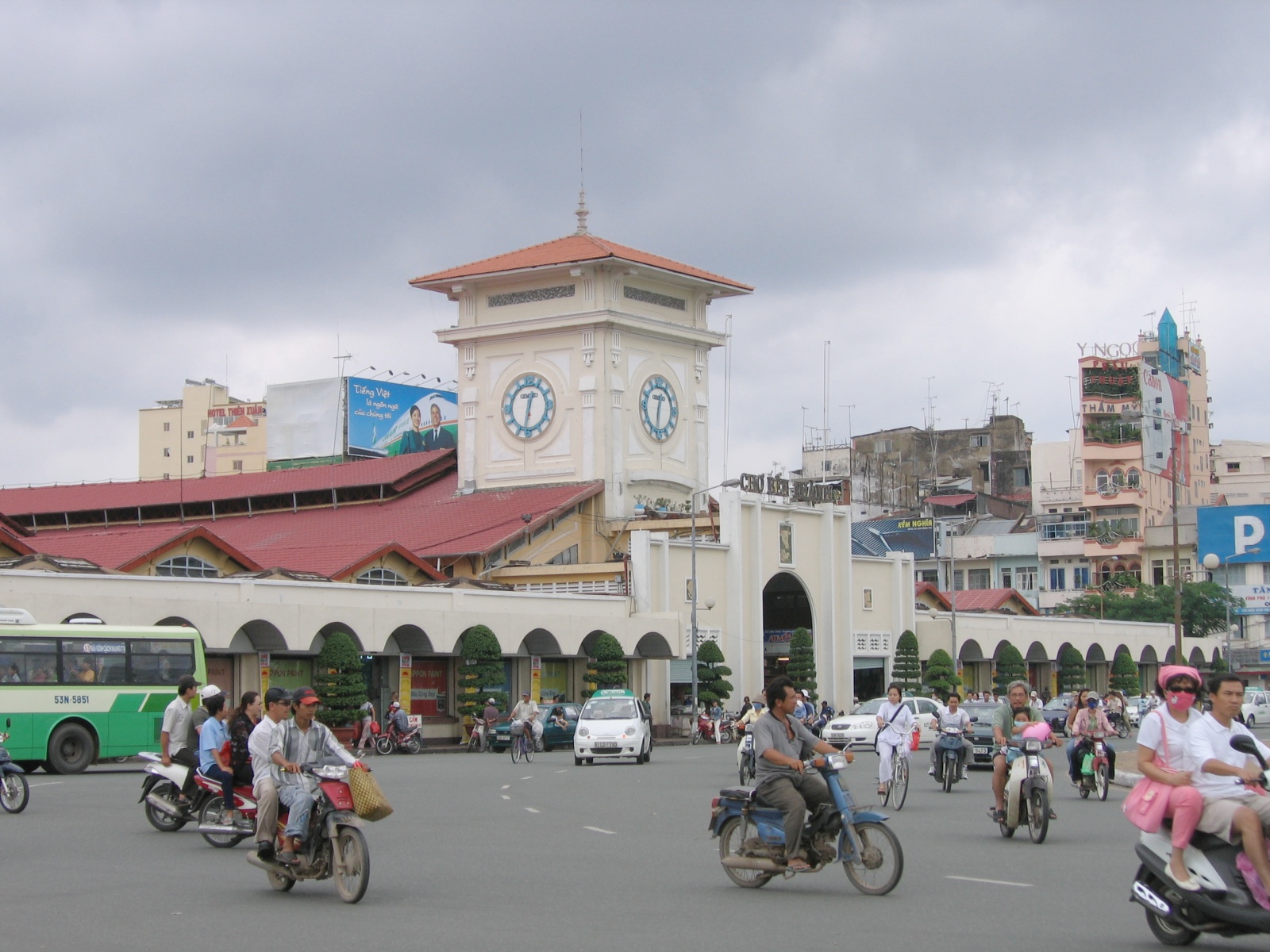
I took a walk around Saigon's tourist-oriented covered market today. It's a labyrinth of clothes, food, cloth, handicrafts and cheap souvenirs. If you're not careful, you will find yourself completely lost in the maze. On the outside, the south side of Ben Thanh Market is one of the iconic symbols of the city. The market has a scalloped, pink-ish façade that stretches the length of the whole block. The square clock tower is a fusion of architectural style, with its Eastern pagoda shape and Western ornamentation and detail. The image of the market was one of my first sights of Vietnam.
Ben Thanh is one of the older buildings in Saigon. The market used to be located along the Saigon River. The word bến means wharf, which means the place has always been associated with visitors who went there to shop. But the market is far from the river now. The stalls and shops were all moved to the present building in around 1912. The enormous building takes up the entire block. Under a roof of stadium proportions are row upon row of vendors and prepared food stalls, with a separate section for a small wet market. We tourists squeeze through the aisles. We're assaulted by friendly, insistent sales pitches. We're treated to a visual, aural, and olfactory smorgasborg. It's incredibly crowded, and I've been warned to look to my wallet and phone, for there's a reputation of pickpockets.
The prepared food is expensive by Saigon standards. Still, you'll get a plate of food and a drink for less than $2. Ordering a meal is a guessing game, because the menu that's offered is not necessarily available. And while you're trying to order, you will be assailed. Elderly beggars shake their gnarled arthritic hands for your change. Competing food stall workers shoo you away from their stalls to open up the space for more interested customers. And you'll find yourself seated on a barstool and squished against a plate barely wider than the ledge it's resting on. Passersby bump into your back as you eat. The food is good enough to eat. When you're done licking your plate clean, you might have room for dessert. So you mosey over to the chè stand, to choose from a chromatic variety of cold sweet soups.
Beyond the prepared food is a specialized section of the larger market called the wet market. These markets, common around Asia, are so named because the floor is perpetually hosed down to wash toward the gutter the scraps of vegetable castings and offal, the drippings of animal blood, and the overrun from bubbling tanks full of live prawns, catfish, and ocean seafood. If you wear flip-flops, consider yourself warned--you will carry some of the floor's soupy wetness out on your toes. These markets are like a magnet that attracts locals in search of the freshest ingredients for their home-cooked dishes. The difference between the wet market in Ben Thahn and the ones in more remote areas is the lack of live birds and mammals that are slaughtered and dressed upon sale. I guess the absence has something to do with avoiding a spectacle for the tourists.
There's enough of a spectacle for the tourists back inside the main part of the market. So I walk back in. From a short stool beneath a mountain of woolen bolts, a young bald man with white spectacles offers to sew me a suit in a day. I walk by the dried and fermented foods, with wall-high stockpiles of pickled vegetables and salted fish parts. At the end of the aisle is a coffee vendor, who offers whiffs of black roasted beans. But the scent of dried fish is overwhelming. I imagine it's hard to sell coffee when it carries the briny scent of dried and fermented fish.
Suddenly, I realize in dismay that I've just entered the t-shirt section. This is the worst place to be when you're a foreigner who is neither shopping nor wants to be hassled. You'd have easier time getting past a hundred smarmy salesmen in a used car lot. Vendors, acclimated to the intimate personal space rules of their usual western clients, feel no taboo with grabbing a tourist as he or she floats by. One tenacious clerk snatches me by the elbow, smirks, and will not let go. I smile broadly and pretended not to speak English, but she will not let go. I tug on my arm. She will not let go. I let slip a miserable groan, and she releases her grip, and I skedaddle.
I run away from the t-shirts, into the clear, and feel like I can breathe again. Now I'm among hoodie sweatshirts, coats, and jackets. These are for tourists to bring back to cold weather climates, or for the Saigon girls riding around on bikes or scooters in the tan-inducing sun. I pass elaborate bone chopsticks, painted lacquerware, handwoven baskets, horn combs and bracelets, shell cutlery, majong and xiangqi games. I see a large woman pointing excitedly at a pile of coasters, and catch phrases of her Eastern European accent as she engages in intense bargaining. I see a Vietnamese vendor push a teenage boy, probably her nephew, off his footstool and onto the ground, where she sits on him until he squeals for mercy.
I grin, turn a corner, and freeze. I realize, again to my dismay, that I've fallen victim to Ben Thanh Market's greatest trick. I have lost my bearings and backtracked. Worst of all, I've inadvertently returned to the t-shirt section. A guy selling knock-off brands and Vietnam soundbites says, oh, you, again?! Here we go...
Sunday, June 26, 2011
The Bark is Worse Than The Bike
Thursday, June 23, 2011
Nước - Water
Status update:
The word nước is the Vietnamese word for water. It forms the root for many compound words, such as the fluids of the body like tears (eye water), mucus, (nose water), and saliva (bubbly water). Some of the compound words are idiomatic expressions. Directly translated, nước trong and nước độc mean clean water and foul water respectively. However, the connotation refers to a married couple and the state of their relationship, whether the relationship is an easy one, or if it takes a lot of effort to sustain. Finally, the word nước is a homonym for country. Considering Vietnam's coastal location and riverine countryside, I imagine the word country takes the meaning: a place where there is water. But that's an uneducated guess on my part.
It's Wednesday--water delivery day. From the stairwell comes loud resonant booms. The delivery person is hauling five-gallon bottles up the flights of stairs before dropping the bottles -ka-choum- on the landing for each floor. He carried the first one up six flights. Then the next one up five, then four, and so on. Each bottle weighs 40 pounds, so this guy must have legs of pure steel cable and the heart of a horse. Once each apartment has a blue bottle of clear water waiting outside the door, he speeds off on his scooter, the same scooter that hauled an eighth of a ton of water to our place.
Having water delivered is a new thing for me. Generally, everything about water is strange and unfamiliar here. The way we get it, what we do with it. We fill ice trays from the waterbottle stand, and we might refill them three times a day. The 220 volt rice cooker comes to a boil in a flash; we go from washing the rice to eating it at the table in 10 minutes flat. There's a cream colored hose with a spray nozzle, hanging from a fixture on the grey tile wall next to the toilet, to provide a specific service in lieu of toilet tissue (although happy to say the plumbing in this house does possess the capability to handle toilet paper--a capability that most household toilets in Southeast Asia lack).
All around the apartment, water is everywhere like beautiful little microclimates. Dishes drying in the chrome rack mounted to the wall above the sink send droplets like rain down on the sink counter. The muddy, still water in the pot holding Lữ's lotus has duckweed floating on the surface--a perfect miniature pond. And every day the monsoons send down relentless torrents of water that pelt the clay tile and corrogated tin rooves, gather in holding tanks until full, then spill out and down to the courtyard to merge into rushing grey rivers underfoot.
And other aspects of water are so unique to this place. On the roof, you can see dragonflies, born of water, darting about after a rain. There on the roof, the chrome holding tank feeds the solar hot water heater, which in turn supplies our entire building with scalding water when the day is at its hottest, and cold water all night. Then on the ground floor, there is the terraced fountain, nestled in the terrarium window garden in our building's front entrance. It fills the first two floors of the house with the hum of the pump and the tinkle of trickling water. And then there's the retching sound. At first I thought it was the hacking coughs of old man fighting a losing battle with lung infection. Then thought it to be the horrible crowing sound of a bird, like a raven, sitting jealous guard upon its nest. However, I just discovered the retching noise belongs to our neighbor--a nice guy, really--who after his meals, sticks his head out the back window of his kitchen, runs water from a spigot that pokes out of the wall across from his window, and gargles from it, religiously, for several minutes at a time, several times a day. The noise echoes up the alley to our kitchen window.
I suppose the most significant aspect of water is the stuff we use for eating and drinking. We drink a lot of the stuff, maybe close to a gallon each day. Thankfully, the bottled stuff is not too expensive, although I'm aware it's a luxury and privilege most of the Vietnamese could not afford. But we prefer the bottled and fossil-fuel transported water over the water that flows from the tap.
This is not to give you the impression that we're water snobs. I know what water snobs are--folks who play right into the hands of the marketers and advertisers who expound in no uncertain terms that bottled water will make you smarter, sexier, and more powerful, and it won't kill you like tap water will. Drink Dasani for life and snub your nose at your tap, so say we all.
I've heard some of our bottled water in the states is supposedly just municipal water with a 3,000 percent markup in price. Here in Vietnam however, municipal water is a different story. The toxins and bacteria in this tap water can and do make people sick. With my own eyes, I can testify there's more that comes through the water lines than water. When the solid clear trunk of water flowing from our sink faucet depreciated to a loose splattery spray, I took the fixture apart to fix it. Peering into the cap, I found the filter screen clogged with all sorts of gunk and debris that came straight from the water system.
That was just the big stuff. The little stuff invariably makes it into the sink, to the place where we wash our dishes and rinse our food. As germ theory holds, bacteria multiply like rabbits with an itch. So not to let standing water sit on our cleaned dishes, we obsessive-compulsively arrange them in the drainrack for optimal air exposure. That seems to do the trick.
I still don't think we're tap water snobs. We do drink Saigon water. Since it's a risk, we filter the water through carbon, then sterilize it on our gas stove. The problem with heating the water is we still end up using fossil fuel. Can't seem to get around that one. And, as a terribly unwelcome side effect, the heat from the stove turns the apartment into a sauna. I might make a couple cups of cà phê sữa đá a day (with water from the filter, not the bottle). But there is a terrible trade-off of sweet, sweet, cà phê for a miserably hot room.
Tap water plays yet another key role: for rinsing fruit and veggies. And boy do they need it. Mike rinsed bunches of cải thìa three times the other day, and still, there was so much sand in the bowl of water on the third time, it made me think of a miner panning for gold. Once the dirt is removed though, we still have to deal with contamination. Before coming to market, veggies get washed in the river and pick up infectious bacteria, according to one study. So, we sterilize the fruits and raw veggies too. This usually means a post-scrub soak in a cocktail of vinegar and our treated tap water.
Would you be surprised at what I'm about to say? I think the most significant difference between Saigon, with its six feet of rain a year, and the Sonoran Desert in the Southwest US, a relatively lush desert that gets about 5-10 inches of rain from its two monsoon seasons, is not the rainfall. The biggest difference is the nasty scaly buildup on the shower and tub, which is a nightmare to remove. There is none here. Mike says the municipal water is river water. The Saigon River is the main source of water for the city. River water lacks the minerals of groundwater that react with soap.
When I'm in the shower, I tend to think of the Saigon River, imagining how the water that is running over me once ran free through the city. And when I'm on the roof and scanning south, I think I can just make out the river and its charcoal grey color beyond the rooftops and skyscrapers in the distance. I've seen it up close a few times, on walks around town, and when Mike and I are driving around. It's more brownish up close, maybe 1,000 feet wide, banked by concrete and some riparian zones. The water meanders and deviates along streets and bridges, buildings and markets, past the Saigon Port, and to the Đồng Nai River beyond the city. There the waters merge and together flow to the South China Sea within a day. This river system is too far north to be part of the Mekong River Delta. Saigon has its own river, with its own thing going on. It's a lovely thing to ponder while I'm here.
Provender:
- breakfast: gỏi cuốn
- lunch : bún chay
- lāo miàn with cải thìa
1. Riffing Indochina now plays well with IE. Spent 4 hours yesterday futzing with a brand new set of programming code to make the blog look exactly like it did before. Same skin, new chassis.
2. Not really a status update, but I don't think I've posted anything about food since my run in with the runs. Mike says I gotta pick myself up and get back on the horse.
3. Headed to Thailand with the family for a week in July. Will still be posting, 97 and-a-half percent positive.
The word nước is the Vietnamese word for water. It forms the root for many compound words, such as the fluids of the body like tears (eye water), mucus, (nose water), and saliva (bubbly water). Some of the compound words are idiomatic expressions. Directly translated, nước trong and nước độc mean clean water and foul water respectively. However, the connotation refers to a married couple and the state of their relationship, whether the relationship is an easy one, or if it takes a lot of effort to sustain. Finally, the word nước is a homonym for country. Considering Vietnam's coastal location and riverine countryside, I imagine the word country takes the meaning: a place where there is water. But that's an uneducated guess on my part.
It's Wednesday--water delivery day. From the stairwell comes loud resonant booms. The delivery person is hauling five-gallon bottles up the flights of stairs before dropping the bottles -ka-choum- on the landing for each floor. He carried the first one up six flights. Then the next one up five, then four, and so on. Each bottle weighs 40 pounds, so this guy must have legs of pure steel cable and the heart of a horse. Once each apartment has a blue bottle of clear water waiting outside the door, he speeds off on his scooter, the same scooter that hauled an eighth of a ton of water to our place.
Having water delivered is a new thing for me. Generally, everything about water is strange and unfamiliar here. The way we get it, what we do with it. We fill ice trays from the waterbottle stand, and we might refill them three times a day. The 220 volt rice cooker comes to a boil in a flash; we go from washing the rice to eating it at the table in 10 minutes flat. There's a cream colored hose with a spray nozzle, hanging from a fixture on the grey tile wall next to the toilet, to provide a specific service in lieu of toilet tissue (although happy to say the plumbing in this house does possess the capability to handle toilet paper--a capability that most household toilets in Southeast Asia lack).
All around the apartment, water is everywhere like beautiful little microclimates. Dishes drying in the chrome rack mounted to the wall above the sink send droplets like rain down on the sink counter. The muddy, still water in the pot holding Lữ's lotus has duckweed floating on the surface--a perfect miniature pond. And every day the monsoons send down relentless torrents of water that pelt the clay tile and corrogated tin rooves, gather in holding tanks until full, then spill out and down to the courtyard to merge into rushing grey rivers underfoot.
And other aspects of water are so unique to this place. On the roof, you can see dragonflies, born of water, darting about after a rain. There on the roof, the chrome holding tank feeds the solar hot water heater, which in turn supplies our entire building with scalding water when the day is at its hottest, and cold water all night. Then on the ground floor, there is the terraced fountain, nestled in the terrarium window garden in our building's front entrance. It fills the first two floors of the house with the hum of the pump and the tinkle of trickling water. And then there's the retching sound. At first I thought it was the hacking coughs of old man fighting a losing battle with lung infection. Then thought it to be the horrible crowing sound of a bird, like a raven, sitting jealous guard upon its nest. However, I just discovered the retching noise belongs to our neighbor--a nice guy, really--who after his meals, sticks his head out the back window of his kitchen, runs water from a spigot that pokes out of the wall across from his window, and gargles from it, religiously, for several minutes at a time, several times a day. The noise echoes up the alley to our kitchen window.
I suppose the most significant aspect of water is the stuff we use for eating and drinking. We drink a lot of the stuff, maybe close to a gallon each day. Thankfully, the bottled stuff is not too expensive, although I'm aware it's a luxury and privilege most of the Vietnamese could not afford. But we prefer the bottled and fossil-fuel transported water over the water that flows from the tap.
This is not to give you the impression that we're water snobs. I know what water snobs are--folks who play right into the hands of the marketers and advertisers who expound in no uncertain terms that bottled water will make you smarter, sexier, and more powerful, and it won't kill you like tap water will. Drink Dasani for life and snub your nose at your tap, so say we all.
I've heard some of our bottled water in the states is supposedly just municipal water with a 3,000 percent markup in price. Here in Vietnam however, municipal water is a different story. The toxins and bacteria in this tap water can and do make people sick. With my own eyes, I can testify there's more that comes through the water lines than water. When the solid clear trunk of water flowing from our sink faucet depreciated to a loose splattery spray, I took the fixture apart to fix it. Peering into the cap, I found the filter screen clogged with all sorts of gunk and debris that came straight from the water system.
That was just the big stuff. The little stuff invariably makes it into the sink, to the place where we wash our dishes and rinse our food. As germ theory holds, bacteria multiply like rabbits with an itch. So not to let standing water sit on our cleaned dishes, we obsessive-compulsively arrange them in the drainrack for optimal air exposure. That seems to do the trick.
I still don't think we're tap water snobs. We do drink Saigon water. Since it's a risk, we filter the water through carbon, then sterilize it on our gas stove. The problem with heating the water is we still end up using fossil fuel. Can't seem to get around that one. And, as a terribly unwelcome side effect, the heat from the stove turns the apartment into a sauna. I might make a couple cups of cà phê sữa đá a day (with water from the filter, not the bottle). But there is a terrible trade-off of sweet, sweet, cà phê for a miserably hot room.
Tap water plays yet another key role: for rinsing fruit and veggies. And boy do they need it. Mike rinsed bunches of cải thìa three times the other day, and still, there was so much sand in the bowl of water on the third time, it made me think of a miner panning for gold. Once the dirt is removed though, we still have to deal with contamination. Before coming to market, veggies get washed in the river and pick up infectious bacteria, according to one study. So, we sterilize the fruits and raw veggies too. This usually means a post-scrub soak in a cocktail of vinegar and our treated tap water.
Would you be surprised at what I'm about to say? I think the most significant difference between Saigon, with its six feet of rain a year, and the Sonoran Desert in the Southwest US, a relatively lush desert that gets about 5-10 inches of rain from its two monsoon seasons, is not the rainfall. The biggest difference is the nasty scaly buildup on the shower and tub, which is a nightmare to remove. There is none here. Mike says the municipal water is river water. The Saigon River is the main source of water for the city. River water lacks the minerals of groundwater that react with soap.
When I'm in the shower, I tend to think of the Saigon River, imagining how the water that is running over me once ran free through the city. And when I'm on the roof and scanning south, I think I can just make out the river and its charcoal grey color beyond the rooftops and skyscrapers in the distance. I've seen it up close a few times, on walks around town, and when Mike and I are driving around. It's more brownish up close, maybe 1,000 feet wide, banked by concrete and some riparian zones. The water meanders and deviates along streets and bridges, buildings and markets, past the Saigon Port, and to the Đồng Nai River beyond the city. There the waters merge and together flow to the South China Sea within a day. This river system is too far north to be part of the Mekong River Delta. Saigon has its own river, with its own thing going on. It's a lovely thing to ponder while I'm here.
Provender:
- breakfast: gỏi cuốn
- lunch : bún chay
- lāo miàn with cải thìa
Scoot Out of Luck
Tuesday, June 21, 2011
Xe Buýt: The Bus
I took the public bus to my lesson today. Saigon has an extensive bus system, with over 100 routes. The map of bus routes bears a striking resemblance to the city's haphazard tangles of electric cables. You're never quite sure where you'll end up when you step onto one of these buses for the first time. Not to mention, in order to actually step onto a bus, you will need a running start.
The first step is figuring out how to get where you want to go. I flipped back and forth between the city bus map and Goggle maps. After a while, I was sure I wanted the 6, heading northeast. The 6 takes me to District 2, across the bridge and over the flat barges that cruise down the sinuous Saigon River.
I skimmed the bus website to find the schedule, but there doesn't seem to be any. That's alright though. From what I can tell, the buses arrive every 10 minutes or so.
I found the nearby bus stop. It was not yet nine o'clock, and the business folks were not yet in the offices. They were on the sidewalk, sipping their breakfast coffees. They wore collared shirts or business dresses, sat on squat plastic stools, and rammed spoons into tall glasses to stir their icy brown cà phê sữa đá. They held morning conversations that were lost under the din of endless scooter engines, honking horns, and the general breath of the city.
The bus stop overhang arched forward, but did little to shade the waiting people from the morning sun. When I got there, three people sat on a bench fashioned from a set of chrome pipes. They ache to sit upon. I have found, during my travels, that bus benches in Asia are not designed for comfort. The bus stop seats in Singapore were a marginal four inches wide. Those were an extravagance compared to Hong Kong, where there were no bus stop seats to be found anywhere.
A bright green bus approached. One of the people at the stop stood and waved. She looked like she was patting the head of a child. The driver of the bus took it as a sign to pull over. The bus muscled past a swath of scooters to get to the curb, slowed to a crawl, and opened its doors--still rolling. The woman who had waved took a few steps in high heels, matched the speed of the bus, grabbed the rail inside and leapt in. The bus never stopped.
When my bus arrived, I was prepared to have to jump on as well. But the bus pulled over and stopped, and a half-dozen people pushed their way through the doors. As soon as the last person was off, the bus started to pull away again. I snatched the rail, jumped, and found myself onboard and en route. I found an empty seat in the back, next to a window. The seats were old nagahide and pleather, like a school-bus from the 1980s. The paint on the rails was worn off by countless hands. I slung my guitar off my shoulders, sat down, and set it between my knees.
A ticketperson in a blue uniform approached me, one hand full of ticket vouchers, the other with a wad of cash. No words were spoken. I handed over a 10,000 note, and she tossed me a blue ticket and 6,000₫ in change. That's roughly 20 cents. I think New York buses may be close to $3 by now.
I settled in to view the city from the bus window. We passed shophouses, corner stalls, more beverage vendors with crowds of business-folks on their plastic stools, stirring their condensed milk into their iced coffees. We passed flashing neon lights in electronic stores, vegetable and fruit carts with hand drawn prices by the kilo, steaming noodle shops, grimy repairmen, scooter drivers barefoot and passed out on their bikes. We passed dealerships and markets, endless scooters and bicycles, narrow alleys and cross streets stretching off into the distance with more of everything. And we passed throngs of people--in the streets, on the sidewalks, strolling about, squatting, shopping, selling, laughing, bargaining, arguing, shoveling, urinating, pedaling, carrying, moving, living, being. The city has no limit. It's as if one could see anything on the Saigon bus.
As the bus rumbled through the streets, I sat gazing at everything, at nothing. But I noticed a taxi driver, pulled over to the curb across the street. He had glanced up from the driver's seat and looked in the direction of my bus. At the sight of me, his head jerked back, his eyes widened, and a smile slowly spread across his face, as if to say, no freaking way. He probably thinks you can see anything on the Saigon bus, too.
The first step is figuring out how to get where you want to go. I flipped back and forth between the city bus map and Goggle maps. After a while, I was sure I wanted the 6, heading northeast. The 6 takes me to District 2, across the bridge and over the flat barges that cruise down the sinuous Saigon River.
I skimmed the bus website to find the schedule, but there doesn't seem to be any. That's alright though. From what I can tell, the buses arrive every 10 minutes or so.
I found the nearby bus stop. It was not yet nine o'clock, and the business folks were not yet in the offices. They were on the sidewalk, sipping their breakfast coffees. They wore collared shirts or business dresses, sat on squat plastic stools, and rammed spoons into tall glasses to stir their icy brown cà phê sữa đá. They held morning conversations that were lost under the din of endless scooter engines, honking horns, and the general breath of the city.
The bus stop overhang arched forward, but did little to shade the waiting people from the morning sun. When I got there, three people sat on a bench fashioned from a set of chrome pipes. They ache to sit upon. I have found, during my travels, that bus benches in Asia are not designed for comfort. The bus stop seats in Singapore were a marginal four inches wide. Those were an extravagance compared to Hong Kong, where there were no bus stop seats to be found anywhere.
A bright green bus approached. One of the people at the stop stood and waved. She looked like she was patting the head of a child. The driver of the bus took it as a sign to pull over. The bus muscled past a swath of scooters to get to the curb, slowed to a crawl, and opened its doors--still rolling. The woman who had waved took a few steps in high heels, matched the speed of the bus, grabbed the rail inside and leapt in. The bus never stopped.
When my bus arrived, I was prepared to have to jump on as well. But the bus pulled over and stopped, and a half-dozen people pushed their way through the doors. As soon as the last person was off, the bus started to pull away again. I snatched the rail, jumped, and found myself onboard and en route. I found an empty seat in the back, next to a window. The seats were old nagahide and pleather, like a school-bus from the 1980s. The paint on the rails was worn off by countless hands. I slung my guitar off my shoulders, sat down, and set it between my knees.
A ticketperson in a blue uniform approached me, one hand full of ticket vouchers, the other with a wad of cash. No words were spoken. I handed over a 10,000 note, and she tossed me a blue ticket and 6,000₫ in change. That's roughly 20 cents. I think New York buses may be close to $3 by now.
I settled in to view the city from the bus window. We passed shophouses, corner stalls, more beverage vendors with crowds of business-folks on their plastic stools, stirring their condensed milk into their iced coffees. We passed flashing neon lights in electronic stores, vegetable and fruit carts with hand drawn prices by the kilo, steaming noodle shops, grimy repairmen, scooter drivers barefoot and passed out on their bikes. We passed dealerships and markets, endless scooters and bicycles, narrow alleys and cross streets stretching off into the distance with more of everything. And we passed throngs of people--in the streets, on the sidewalks, strolling about, squatting, shopping, selling, laughing, bargaining, arguing, shoveling, urinating, pedaling, carrying, moving, living, being. The city has no limit. It's as if one could see anything on the Saigon bus.
As the bus rumbled through the streets, I sat gazing at everything, at nothing. But I noticed a taxi driver, pulled over to the curb across the street. He had glanced up from the driver's seat and looked in the direction of my bus. At the sight of me, his head jerked back, his eyes widened, and a smile slowly spread across his face, as if to say, no freaking way. He probably thinks you can see anything on the Saigon bus, too.
Thursday, June 16, 2011
Indulgences
Today is the fifteenth day of the lunar month, and the night sky bears a full moon. Last night was a lunar eclipse, but it was overcast in Saigon, as it has been every night. In Vietnam, the custom is to eat no meat on the new and full moons. But I was not a vegetarian today. I chowed down on an enormous bowl of phở, that trademark dish of Vietnamese cuisine. Phở has two common purposes: breakfast, and remedy for hangover. Today, my first bowl of pho since arriving in Vietnam served both purposes.
Rewind 24 hours. Mike and I were walking to a dance when we dropped into a street market for some dinner. At first, we tried taking a seat at a curbside vendor. But suddenly, the wind came up so hard that signs fell over and branches snapped and dropped out of the trees. Considering we were sitting directly beneath Saigon's notorious power lines, we decided to seek some indoor place to wait out the wind and the rain.
We took shelter from the storm and sat down in a room with grimy walls, plastic chairs, and the sorrowful crying of soap opera actresses on the television. Mike poured 333 brand beer into a plastic mug brimming with ice. I set to work on a bowl of chicken soup with yellow rice-noodle macaroni. The rain outside continued to beat down on scooters and taxis. We watched two drenched guards change watch at the British consulate across the street. I finished the last of the soup, but the deluge showed no sign of stopping. The choice: stay or face the torrential downpour.
Fast forward two hours and now I've been instructed on the way to order beer. I've used this newly-learned verbage twice. The rain has subsided to a drizzle, so we've begun our walk home, and have been snacking on tasty shredded coconut and black sesame wrapped in tender rice-flour crêpes. Once home, Mike has himself a hankering for hot cocoa, makes two, and applies a shot of Amarula to each. It's been several months since I've had a drink, and now I've had three. To make matters worse, I've mixed drink types. This bodes poorly for my noggin. When the morning comes, I'm gonna need that phở. "Nature's perfect hangover food," Mike calls it.
It was the most delicious remedy--a bowl of expertly assembled fresh noodles, assorted beef cuts, sprouts, onions, herbs, chilis, all swimming in richly seasoned oxtail broth, sprinkled with squeeze of lime. Mostly cured of my fat head, I climbed on the scooter behind Mike, and we scooted across town, through sunshowers and shopping districts. We arrived in Cho Lon, a famous market in central Saigon.
We parked the bike. The lady at parking charged us 25 percent more than her other customers because "it was an expensive bike." Mike hates when he asks a price and the vendor pauses, as if to size us up, before responding with some inflated amount. It seems to happen wherever we go, so he's stopped asking. Unless the price is marked, we get hit up for more money than the locals pay. Lu calls it the foreigners' tax. Apparently, at one point the disparity was government sanctioned. As the story goes, at government used to require two ticket prices for its tourist destinations, one for locals and one for foreigners like westerners, Japanese and Koreans--the wealthy folks who can afford to be gouged. Whether or not that story's true, a lot of vendors I run into seem to be quite content with the policy.
In the cho, Mike and I did a double take when we spotted a fruit that looked like red jackfruit. We asked about it, found out that it's called quả gấc, bought a small one, split it open and found lobes of bright red fruit inside. The segments looked looked like hemoglobin-enriched organs. We had no utensils, so a couple bites later our fingers looked greusome, as if we were doing thoracic surgery with bare hands.
We walked through the market. As we did, people stared at us. I didn't see any other westerners, so I normally wouldn't be surprised. But today, our onlookers snatched quick, knowing glances at each other, laughed hard, and pointed in our direction. A lady shouted at us, asking if the fruit, which clung to our fingers like gore, was sweet. Mike said, she's asking if it's sweet. I said, no, but I thought it was still tasty. We meandered among stalls of stainless steel, grass, and dried food products and contemplated the fruit's bright sanguine color. The reason for it, Mike said, was the carotenoids, like lycopene and beta carotene that the body uses to synthesize vitamin A.
People still couldnt get enough of the sight of us, strolling through the market with our bloody-fruit soaked fingers like we were casually departing from a violent crime scene. A grey haired vendor in a nón lá couldn't seem to take it anymore. She abandoned her stall, waddled up to us and waggled her finger no, as if to say, stop eating that right now. She chattered excitedly at us. Mike understood some of it. In Vietnamese medicine, the fruit is hot food. Bad to eat. Mike said thanks and we walked away.
We didn't walk another ten feet before some other ladies stopped us. They warned us, if we keep eating that fruit, we'll get stomach aches. To emphasize their sincerity, one of the ladies jabbed a plastic bag toward me to put the gấc inside.
I haven't been sick since I got here, and in no mood to break my stride. I still don't know why the fruit was supposedly bad to eat. Wikipedia has nothing but good things to say about it, (unlike the soursop, which I had last week and is allegedly linked to Parkinsons). Better safe than otherwise, I bagged remaining gấc and threw it on a pile of trash in the sunny gutter outside. I ducked back into the market, found Mike, and then found the old lady. She looked so relieved to see us without the gấc that she gave us six lychees. Another hot food. And for some reason, they were the best I have ever tasted. No stomach ache, either.
Rewind 24 hours. Mike and I were walking to a dance when we dropped into a street market for some dinner. At first, we tried taking a seat at a curbside vendor. But suddenly, the wind came up so hard that signs fell over and branches snapped and dropped out of the trees. Considering we were sitting directly beneath Saigon's notorious power lines, we decided to seek some indoor place to wait out the wind and the rain.
We took shelter from the storm and sat down in a room with grimy walls, plastic chairs, and the sorrowful crying of soap opera actresses on the television. Mike poured 333 brand beer into a plastic mug brimming with ice. I set to work on a bowl of chicken soup with yellow rice-noodle macaroni. The rain outside continued to beat down on scooters and taxis. We watched two drenched guards change watch at the British consulate across the street. I finished the last of the soup, but the deluge showed no sign of stopping. The choice: stay or face the torrential downpour.
Fast forward two hours and now I've been instructed on the way to order beer. I've used this newly-learned verbage twice. The rain has subsided to a drizzle, so we've begun our walk home, and have been snacking on tasty shredded coconut and black sesame wrapped in tender rice-flour crêpes. Once home, Mike has himself a hankering for hot cocoa, makes two, and applies a shot of Amarula to each. It's been several months since I've had a drink, and now I've had three. To make matters worse, I've mixed drink types. This bodes poorly for my noggin. When the morning comes, I'm gonna need that phở. "Nature's perfect hangover food," Mike calls it.
It was the most delicious remedy--a bowl of expertly assembled fresh noodles, assorted beef cuts, sprouts, onions, herbs, chilis, all swimming in richly seasoned oxtail broth, sprinkled with squeeze of lime. Mostly cured of my fat head, I climbed on the scooter behind Mike, and we scooted across town, through sunshowers and shopping districts. We arrived in Cho Lon, a famous market in central Saigon.
We parked the bike. The lady at parking charged us 25 percent more than her other customers because "it was an expensive bike." Mike hates when he asks a price and the vendor pauses, as if to size us up, before responding with some inflated amount. It seems to happen wherever we go, so he's stopped asking. Unless the price is marked, we get hit up for more money than the locals pay. Lu calls it the foreigners' tax. Apparently, at one point the disparity was government sanctioned. As the story goes, at government used to require two ticket prices for its tourist destinations, one for locals and one for foreigners like westerners, Japanese and Koreans--the wealthy folks who can afford to be gouged. Whether or not that story's true, a lot of vendors I run into seem to be quite content with the policy.
In the cho, Mike and I did a double take when we spotted a fruit that looked like red jackfruit. We asked about it, found out that it's called quả gấc, bought a small one, split it open and found lobes of bright red fruit inside. The segments looked looked like hemoglobin-enriched organs. We had no utensils, so a couple bites later our fingers looked greusome, as if we were doing thoracic surgery with bare hands.
We walked through the market. As we did, people stared at us. I didn't see any other westerners, so I normally wouldn't be surprised. But today, our onlookers snatched quick, knowing glances at each other, laughed hard, and pointed in our direction. A lady shouted at us, asking if the fruit, which clung to our fingers like gore, was sweet. Mike said, she's asking if it's sweet. I said, no, but I thought it was still tasty. We meandered among stalls of stainless steel, grass, and dried food products and contemplated the fruit's bright sanguine color. The reason for it, Mike said, was the carotenoids, like lycopene and beta carotene that the body uses to synthesize vitamin A.
People still couldnt get enough of the sight of us, strolling through the market with our bloody-fruit soaked fingers like we were casually departing from a violent crime scene. A grey haired vendor in a nón lá couldn't seem to take it anymore. She abandoned her stall, waddled up to us and waggled her finger no, as if to say, stop eating that right now. She chattered excitedly at us. Mike understood some of it. In Vietnamese medicine, the fruit is hot food. Bad to eat. Mike said thanks and we walked away.
We didn't walk another ten feet before some other ladies stopped us. They warned us, if we keep eating that fruit, we'll get stomach aches. To emphasize their sincerity, one of the ladies jabbed a plastic bag toward me to put the gấc inside.
I haven't been sick since I got here, and in no mood to break my stride. I still don't know why the fruit was supposedly bad to eat. Wikipedia has nothing but good things to say about it, (unlike the soursop, which I had last week and is allegedly linked to Parkinsons). Better safe than otherwise, I bagged remaining gấc and threw it on a pile of trash in the sunny gutter outside. I ducked back into the market, found Mike, and then found the old lady. She looked so relieved to see us without the gấc that she gave us six lychees. Another hot food. And for some reason, they were the best I have ever tasted. No stomach ache, either.
Provender
Monday, June 13, 2011
Sofa to go...
Sunday, June 5, 2011
The airport in Ho Chi Minh City (which I will, from now here on after, refer to as Saigon) looks like every other airport I've ever been to. I didn't feel like I was in another country until I stepped outside through the automatic doors to the sweltering balmy air that carried rich wafts of smoky incense. Strange as it may seem for such a smoggy, crowded city that looks about as densely developed as Hong Kong, but Saigon actually smells pretty good.
I had my hands full. Along with my straw hat and green guitar, I had the frame backpack which was all I needed for a month of backpacking in Europe. I also dragged behind me two blue, wheeled suitcases like a pair of mules loaded with gifts and odd-and-ends that are hard to find in Vietnam. Never in my life have I traveled with so many bags.
At least a hundred people crowded outside the terminal waiting for arrivals. My bro and sis-in-law, each carrying a scooter helmet, found me through the crowd and ushered me and my canvas mules toward the rickety bus waiting to take us to my home for the next six months. Mike was wearing the shamrock shirt that goes with the baseball cap I was wearing--both were Christmas gifts from Kevin. T'was heart-warming to see them back together again.
Currency exchangers in the airport usually charge excessive fees, because hey, what choice do you have, so I still didn't have any đồng on me when we got on the bus. Lucky for me, Lữ came along for the ride to help me find my way home. She talked with the bus driver and negotiated the price, which may have been a bit excessive, since he charged full bus fare for each of my bags. Lữ picked up the tab, which was, by local standards, exorbitant. For the two of us and the three bags, the total came out to be 20,000₫, or about a dollar.
The bus sped off among throngs of scooters and taxis. The streets are a raging cacophony of tiny two-cycle engines revving up and ceaseless feeble beeps from scooter horns. Crossing at an intersection takes fortitude, faith, and luck. Lữ says the safest way to cross is at a brisk, consistent pace. Almost all the scooters will steer clear of you that way, and most of the cars. Not the buses though. Mike says the buses will honk a few times before they run you over. To me, it seems like a collision with a bus would be the hard one to walk away from.
Occasionally, you'll see a really fancy car on the streets as well. Later that night, Mike spotted a Bentley, and told me that, on top of its $200,000 price tag, the government in Hanoi slaps on a 100 percent import tax. You might ask, wait a minute, how can someone in a communist country afford that kind of extravagance? Needless to say, there's some disparity among classes in this people's nation. Average wages for folks in Saigon is around $200 a month. That doesn't buy a lot of Bentleys. Communism ain't what it used to be.
Flashes of scenery though the bus windows and, later on, a stroll through the city confirmed my initial impression: Saigon looks a lot like Kuala Lumpur in Malaysia, and not much different than Singapore. Which makes sense. All three cities are bustling trade centers which were once colonial capitals, with a melange of contemporary, traditional, and Euro-Asian architecture set among rows upon rows of shop-houses. Although here in Saigon, the Indio-British style with neo-classical features like rounded arches is largely absent compared to Malaysia and Singapore; in its place is the sharp, Gothic architecture characteristic of French influence.
A perfect testimony of the stark contrast of new and old, perhaps, is the bundles upon bundles of telephone and electric wires overhead. They look like like rubbery-thick black tendrils of steam-punk vines that darken the sky and choke out all other forms of life. Whereas with most cities, in which the electricity that powers them is routed underground, here the wires are in the same location they were when the city was first electrified. It's as if the first electric wires that were installed so many ago were never replaced; they were just built layer upon layer with every successive generation.
The bus pulled into the stop, and we climbed out with bags in tow. Beyond the bus station was the notable Quách Thị Trang Square, which features a horse and rider statue in homage to a general who led the Vietnamese in their independence from China in the 15th century. Across the square was Bến Thành Market, which contains all manner of tasty foods and souvenirs. From there, it was a short walk in the balmy heat to Mike and Lữ's charming little apartment in a quiet ex-pat community in district 1, where its easy to hear the bells of the Notre Dame cathedral around the corner. With only two hours of sleep since the morning of my 19-hour flight, the rest of the day went by in a blur. But, between narcoleptic-like fits at the restaurant with Mike and Lữ, I remember feeling incredibly happy to be here.
Provender:
Bánh xèo with coconut buds
I had my hands full. Along with my straw hat and green guitar, I had the frame backpack which was all I needed for a month of backpacking in Europe. I also dragged behind me two blue, wheeled suitcases like a pair of mules loaded with gifts and odd-and-ends that are hard to find in Vietnam. Never in my life have I traveled with so many bags.
At least a hundred people crowded outside the terminal waiting for arrivals. My bro and sis-in-law, each carrying a scooter helmet, found me through the crowd and ushered me and my canvas mules toward the rickety bus waiting to take us to my home for the next six months. Mike was wearing the shamrock shirt that goes with the baseball cap I was wearing--both were Christmas gifts from Kevin. T'was heart-warming to see them back together again.
Currency exchangers in the airport usually charge excessive fees, because hey, what choice do you have, so I still didn't have any đồng on me when we got on the bus. Lucky for me, Lữ came along for the ride to help me find my way home. She talked with the bus driver and negotiated the price, which may have been a bit excessive, since he charged full bus fare for each of my bags. Lữ picked up the tab, which was, by local standards, exorbitant. For the two of us and the three bags, the total came out to be 20,000₫, or about a dollar.
The bus sped off among throngs of scooters and taxis. The streets are a raging cacophony of tiny two-cycle engines revving up and ceaseless feeble beeps from scooter horns. Crossing at an intersection takes fortitude, faith, and luck. Lữ says the safest way to cross is at a brisk, consistent pace. Almost all the scooters will steer clear of you that way, and most of the cars. Not the buses though. Mike says the buses will honk a few times before they run you over. To me, it seems like a collision with a bus would be the hard one to walk away from.
Occasionally, you'll see a really fancy car on the streets as well. Later that night, Mike spotted a Bentley, and told me that, on top of its $200,000 price tag, the government in Hanoi slaps on a 100 percent import tax. You might ask, wait a minute, how can someone in a communist country afford that kind of extravagance? Needless to say, there's some disparity among classes in this people's nation. Average wages for folks in Saigon is around $200 a month. That doesn't buy a lot of Bentleys. Communism ain't what it used to be.Flashes of scenery though the bus windows and, later on, a stroll through the city confirmed my initial impression: Saigon looks a lot like Kuala Lumpur in Malaysia, and not much different than Singapore. Which makes sense. All three cities are bustling trade centers which were once colonial capitals, with a melange of contemporary, traditional, and Euro-Asian architecture set among rows upon rows of shop-houses. Although here in Saigon, the Indio-British style with neo-classical features like rounded arches is largely absent compared to Malaysia and Singapore; in its place is the sharp, Gothic architecture characteristic of French influence.
A perfect testimony of the stark contrast of new and old, perhaps, is the bundles upon bundles of telephone and electric wires overhead. They look like like rubbery-thick black tendrils of steam-punk vines that darken the sky and choke out all other forms of life. Whereas with most cities, in which the electricity that powers them is routed underground, here the wires are in the same location they were when the city was first electrified. It's as if the first electric wires that were installed so many ago were never replaced; they were just built layer upon layer with every successive generation.
The bus pulled into the stop, and we climbed out with bags in tow. Beyond the bus station was the notable Quách Thị Trang Square, which features a horse and rider statue in homage to a general who led the Vietnamese in their independence from China in the 15th century. Across the square was Bến Thành Market, which contains all manner of tasty foods and souvenirs. From there, it was a short walk in the balmy heat to Mike and Lữ's charming little apartment in a quiet ex-pat community in district 1, where its easy to hear the bells of the Notre Dame cathedral around the corner. With only two hours of sleep since the morning of my 19-hour flight, the rest of the day went by in a blur. But, between narcoleptic-like fits at the restaurant with Mike and Lữ, I remember feeling incredibly happy to be here.
Provender:
Bánh xèo with coconut buds
Subscribe to:
Posts (Atom)