Showing posts with label History. Show all posts

Thursday, September 22, 2011

Hồ Chí Minh's Name

胡志明

I'm deliriously elated. I just recognized all the characters in Hồ Chí Minh's name as it's written in chữ Nôm. I realized this as I'm sitting in a principal's office, taking a break between classes. I'm here working part time teaching English to 12-year-olds. It's also one of the first times I've ever been in a principal's office without having been sent there by a frustrated teacher who's had it up to here with my shenanigans.

I'm staring at a plaque that hangs above the window overlooking the school's courtyard. The plaque bears the smiling face of Uncle Hồ, as he's affectionately called by many here in Vietnam. The plaque depicts his name in the traditional Vietnamese script, which is essentially Chinese characters that were borrowed and adapted. These characters on the plaque appear exactly the same in Chinese as they do in chữ Nôm.


I recognize the first character from early this summer, when I had started to learn about the the Chinese two-stringed violin. In Chinese, the instrument is called èrhú, or 二胡. The name of this instrument in Vietnamese is đàn hồ. Đàn is Vietnamese for stringed instrument, and hồ is borrowed from the Chinese word hú. It's also the same hồ as in Uncle Hồ.

On this plaque bearing Uncle Hồ's picture, I saw the character for hú. The Vietnamese word hồ has a different meaning than its Chinese root word. In modern Chinese, hú means barbarian, foreigner, or wild, and it could mean recklessly or foolishly. And what's more, it's paradoxically both a common Chinese surname, and a term for someone from beyond China's borders. In chữ Nôm, the character 胡 has two pronunciations: hồ and hò. Hò means to sing, or to acclaim, and the only meaning of hồ is a surname.

志明
The other two characters on the plaque are Chí and Minh, and these are Uncle Hồ's given name. I didn't recognize how to say chí, or what it meant. But I recognized the two characters that chí is made of. The top one means scholar or officer. The bottom one means heart, mind, and soul. Poetic, I know: the mind of the scholar, the heart of the soldier. In chữ Nôm, the character chí means to have will power, or to be pious. Minh is one of the coolest words. The two characters that make up minh are the sun and the moon. In Chinese, this character is means bright, in the sense of light. However, in Vietnamese the word describes someone who is insightful and wise.

I suppose it's worth a mention, in a post about Hồ Chí Minh's name, that this was a name he chose for himself. It's also worth a mention that he held many names. When he was born, he was called Nguyễn Sinh Cung, and was given a new first name, Tất Thành, when he turned 10. In his twenties, he took the name Văn Ba. By the time he reached his thirties, he called himself Nguyễn Ái Quốc. He held this name for most of his adult life, aside from two visits to China in which he went by Lý Thụy and Hồ Quang respectively, a stay in Siam (now known as Thailand) when he was known as Thầu Chín, a period in Hong Kong when he was known as Tống Văn Sơ, and a visit to Moscow, when he called himself Lin. When he returned to Vietnam, he went by Già Thu before finally calling himself Hồ Chí Minh. Today, people call him Uncle Hồ.

Mind you, it wasn't me who imposed an archaic representation of Uncle Hồ's name upon him. I'm only reporting on the plaque hanging in the principal's office. Someone in charge of deciding what should be displayed in this institution of higher learning felt that the chữ Nôm version of Uncle Hồ's name would enrich the students' education. The decision might have been in deference to Uncle Hồ's early career, when he taught chữ Hán, or Chinese script, at a school in Phan Thiết.

I am not under any illusion that this plaque will have any impact on its intended audience. Not a single kid at that school, in all 50 classes with 45 students each, not a single one of them will notice or care. But maybe a fraction of a percent of the nerdy kids will develop an interest after they grow up to become part-time historians, language hobbyists, or all-around renaissance men and women. They could find themselves here someday, in the principals office--maybe to pick up their own child from school, or to start a new job. Here, they will see Uncle Hồ's name in a way that begs to be understood. And they'll begin to wonder. Maybe that's why Uncle Hồ is smiling like he does. Or, not.

Sunday, August 21, 2011

How We Got New York

"He who controls the spice, controls the universe."
Baron Vladimir Harkonnen
(Dune)
It all began with nutmeg and mace, the spices that come from the seeds of the nutmeg tree. Long ago, this tree grew exclusively on one of the Banda Islands in Indonesia, which was the world's only source for nutmeg and mace. This island is known as Run Island.

By the 1600s, Europe had become prosperous. Its demand for commodities and luxuries extended to spices of Southeast Asia. European appetites craved the exotic flavors and the preservative ability of spice, particularly fragrant nutmeg. With the introduction of oceanfaring ships, European traders launched fleets of large trading vessels bound for the Spice Islands of Indonesia to retrieve spices for the European market. Nutmeg, being the most rare, was also one of the most valuable. Much blood was shed in the effort to control Run Island.

Britain was first to claim Run Island as a colony, effectively giving Britain exclusive control over the nutmeg trade. The Dutch Republic challenged Britain's monopoly, seized the island, and expelled the British. Conflict over trade escalated into full out war.

Britain reclaimed title to Run Island after the First Anglo-Dutch War. But the Dutch refused to leave, and drove British traders away with the exception of a single year, in 1665, when the British had access to the spice, and more importantly, to the trees. Britain initiated the Second Anglo-Dutch War, which resolved with the Treaty of Breda. Britain ceded claim to Run Island to the Dutch Republic.

It appeared that the Dutch had received the better end of the bargain. The Dutch got to keep their monopoly on the nutmeg trade. But Britain had pulled a fast one. At some point, perhaps during their presence on Run Island in 1665, the British had transferred nutmeg trees to their other colonies. The British could then grow their own nutmeg for trade, and the Dutch monopoly on nutmeg was broken.

One more thing. In exchange for their claim on Run Island, the Dutch gave up their fort in the Americas. Perhaps the Dutch believed that the monopoly they thought they held on nutmeg would be many times more profitable than the American fur trade. So they abandoned Fort New Amsterdam, on an island at the mouth of the Hudson. Little were the Dutch to know that this place would soon be the primary gateway from Europe into what would soon be known as the United States.

Why they call New York the big apple, and not the big nutmeg, is another story.

Friday, August 5, 2011

Early Vietnam - Sa Huỳnh

The union of the Âu Việt and Lạc Việt cultures led to the rise of the Âu Lạc civilization. This merger marked a significant era in early Vietnamese history, because Âu Lạc is considered to be the first civilization that eventually became Vietnam. However, another civilization existed during the same time period in what is now southern Vietnam. This contemporaneous culture was the Sa Huỳnh. It preceeded Âu Lạc by about 800 years, and lasted half a millenium longer.

Artifacts of the Sa Huỳnh culture were found in the Mekong Delta region. These include glass and jade jewelry, particularly double-headed-animal earrings, as well as weapons and tools made of iron. Sealed jars with cremated ashes and offerings inside give us a clue as to how the Sa Huỳnh interred their dead.

The Sa Huỳnh culture had tremendous influence on Vietnamese history. Not only was it a trade center that drew Chinese traders through early Vietnam, they were also a channel for directing early Vietnamese products such as the bronze drums of the Đông Sơn throughout Southeast Asia. However, the Sa Huỳnh's most major contribution to Vietnamese history was its successors, the Champa. Vietnam's conflicts with the Champa lasted throughout the centuries, and the Champa's eventual defeat and assimilation shaped Vietnam's past and demography--a subject to be discussed at a later time.

As significant as Sa Huỳnh and its legacy was, no civilization shaped the course of Vietnamese history, or the nature of its society, as much as its northern neighbor. By the time Âu Lạc was only a few decades old, China had witnessed its most dramatic political and geographic change of all time. The first Chinese emperor brought all of the ancient states under a single authoritative power. With the establishment of a unified China, the Qin emperor's attention turned to conquering the trade routes and agriculturally productive lands to the south beyond the limits of his empire, and a new era in Vietnamese hisory began.

We'll leave history alone for now, and pick it up again in a few days.

Wednesday, August 3, 2011

Early Vietnam - Âu Lạc

The word Âu Lạc is exceptionally interesting. It's an amalgam of the words Lạc Việt and Âu Việt, the two major cultures that existed in northern Vietnam during the bronze age. But there's more to the name if you consider Vietnam's origin myth. The 100 children of the dragon lord and the daughter of the faeries were separated. Fifty accompanied their father, Lạc Long Quân, to the coast. They were called Lạc, after the dragon lord. The other fifty went to the mountains with Âu Cơ, their mother, and were thereafter called Âu. When these two groups merged and formed Âu Lạc, the cultural significance means that the descendants of the dragon and the faery were once again reunited.

For eighteen generations, the Hồng Bàng dynasty ruled the Lạc Việt people near modern day Đông Sơn, which is considered to be the first Vietnamese civilization. Meanwhile, a confederacy of tribes called the Âu Việt lived in the northern mountains, where Vietnam, Guangdong and Guangxi meet.

The Âu Việt were not the most powerful group in Vietnam. They did not enjoy the privilege of location that the Lạc Việt had. The trade-route between China and Southeast Asia passed through the flat coastal plains where the Lạc Việt held their kingdom. To be situated along this route was a very advantageous position for trade and prosperity. We know that the Lạc Việt engaged in far-reaching trade. Their bronze artifacts have been unearthed as far away as Java and Bali.

In 258 B.C.E. the Âu Việt seized control of Lạc Việt. A man named Thục Phán led an army from the mountains against the civilization on the coastal plains. Where Thục came from is still a matter of scholarly debate, whether he was ethnically Chinese, or native Vietnamese. In either case, historians agree that he defeated the 18th Hùng king, and he merged the Âu Việt and Lạc Việt cultures into one, called Âu Lạc. Whether his primary goal was the reunification of the descendants of the dragon and faery, or if it was to gain the advantageous position along the Southeast Asian trade-route, I can't say.

The Thục dynasty ruled Âu Lạc in Cổ Loa, just north of present day Hanoi. It lasted fifty years, until conquered by an army under the first emperor of unified China, and became Nam Việt under China's Qin Dynasty.

Far to the south, the Sa Huỳnh culture remained relatively isolated from Chinese influence. The cultural contributions that they and their successors made upon Vietnam are considerable, although less significant than the influence of the Chinese. We'll explore this culture a little bit tomorrow.

Tuesday, August 2, 2011

Early Vietnam - Đông Sơn

The other day, I posted about the dragon lord, Lạc Long Quân, the legendary father of Vietnam. In the post, I mentioned how Lạc Long Quân destroyed a monstrous fish that had plagued the early people of Vietnam. Lạc Long Quân took metal, melted it, molded it into the shape of a man, and threw the hot metal lure into the water. The fish swallowed the burning hot metal, which seared its throat. While it was distracted by the pain, the dragon lord attacked the giant fish with his sword and cut it into three pieces.

It's interesting to note the tremendous role that metal plays in Vietnam's origin myth. The story tells us that power belongs to those who can wield metal. This story belongs to the ancient Vietnamese, called the Lạc Việt. They were named after the dragon lord himself, and were descended from fifty sons that the dragon lord took with him to the coastal plains. The other fifty were sent to the mountains with their mother--I mention this because it will play a role a little later. Today, the people of Vietnam consider the Lạc Việt to be the beginning of Vietnamese culture. The Lạc Việt are believed to have founded a civilization called Văn Lang, sometime around 3000 B.C.E. Their relics are found near Đông Sơn in Northern Vietnam.

The Đông Sơn culture embodied the best of bronze-age technology. Their remains include a variety of iron and bronze tools, weapons, and musical instruments. Most of all, the Đông Sơn are world renowned for their masterful design of bronze drums. Highly embellished and elaborate, these drums were manufactured by lost-wax casting. Although China was a contemporary civilization that shared bronze-casting technology, some scholars believe the ancient Vietnamese borrowed the lost-wax casting technique from the ancient Thais. I'll let the scholars battle it out.

The Lạc Việt kings were called Hùng, their dynasty was the Hồng Bàng, and they are believed to have ruled for more than two and-a-half thousand years. Their rule ended when the Hùng were defeated by and then assimilated into another contemporary Vietnamese civilization, who were the descendants of the remaining fifty sons of the dragon lord. I'll discuss them and the final civilization that coexisted with the Lạc Việt over the next few posts.

Monday, August 1, 2011

The Stone Age

In a partially-excavated archaeological dig, in the northern Vietnamese province of Hòa Bình, a squirrely archaeologist's intern brushes caked Red River sediment off a piece of flaked cobble. The stone's sharp edge indicates that a prehistoric human has knapped, or shaped, one side of the stone into a sharp blade-like edge. This stone shares its single-edge characteristic with many other stone pieces found here and at 120 other sites. The edge is worn down, which suggests ancient hands put it to work. Perhaps the tool was used to open shells or comb coiled clay into pottery, because traces of both were also found at the site.

The rock tool is tagged, bagged, then dragged into a lab. An arcane carbon-dating procedure reveals that this knife sliced through organic material roughly 8,000 to 10,000 years ago. This tool dates back to roughly the same time period as many other tools in the region. Their discovery suggests that the culture that made them was widely distributed around the Red River delta toward the end of the last ice age. We might never know what word these people used to refer to themselves. We simply call them Hòa Bình, because that's the name of the region where we find their artifacts.

We find similar stone tools in other regions. In Phú Thọ province, the artifacts represent a much older culture than Hòa Bình. The people of the Sơn Vi culture lived between 12,000 and 20,000 years ago. Their remains have been found at 160 sites in northern Vietnam. Their knives are distinctly different from the ones in Hòa Bình. They are smaller, and the knapping is more rough.

Elsewhere, in Thanh Hóa, which is the same province where Hanoi is located, the evidence suggests a more recent stone-age culture. Called Đa Bút, they thrived about five to six thousand years ago. Their pottery is more advanced than the earlier cultures, and their stones tools are polished. The midden piles at these sites tell us that the people hunted and fished, and they probably had livestock and grew rice.

All of these cultures were stone-age, and yet they were quite different from one another. This difference is because the stone age is a gradient of humanity's shift from hunter-gatherer societies into agrarian ones. We see this shift manifested in the artifacts. The middle period knives of the Hòa Bình are larger, sharper, and more refined compared to the earlier Sơn Vi period. The finely polished tools in Thanh Hóa are more advanced still.

These tool advancements over time reflected a change in the way people lived. During the early stone age, humans migrated about the land on the hunt for megafauna. As they found fewer and fewer large animals to hunt, they also discovered the little, fast ones were quite difficult to catch. So they began to domesticate animals, grow plants, and sculpt heavy earthen vessels, with which to store food. There was an advantage to staying in one place, and so, human society became agricultural. Toolmaking skills became more finely honed, and toolmakers made more sophisticated tools.

This change from hunter-gatherers to agriculturalists happened gradually over millennia. However, whenever people settled in Vietnam remains a mystery. Our only option is to look at the things they left behind and make a guess. The tools of the Sơn Vi culture reveal to us that people were living in the Vietnam region at least 12,000 years ago, and as far back as 20,000 years. Whether they became the people we call the Hòa Bình, and eventually the Đa Bút people, the ancient tools cannot say.

Artifacts tell us some of what we want to know about their cultures, but not all. A stone knife or a midden of shells might give us a clue about what kind of food people ate. But the artifacts cannot give us details about the culture such as table manners, or how they used to say "please pass the clams."

The relics from the stone age give up few secrets about the transition into the bronze age. Perhaps the stone-age people learned about metal from a nearby civilization, but whether it was ancient Thailand to the west, or China to the north, scholars are still in disagreement. Or perhaps advanced foreigners settled in the rich river delta and shared bronze technology as they intermingled with the established stone-age cultures. It's also possible that the stone-age people were simply displaced by an aggressive, superior force. The artifacts don't say. The only thing we can say for certain is through their eventual disappearance--sometime around 5000 B.C.E., the stone-age gave way to the era of bronze.

Sunday, July 31, 2011

Digging in the Dirt

Good scholars, honest scholars, will continue to differ about the interpretation of archaeological remains simply because archaeology is not a science. It is an art. And sometimes it is not even a very good art.
-William Dever
Reassembling the past from the archaeological record is like trying to piece together the last chapter of a novel when all the earlier chapters of the book have been torn to shreds; all you have to go by are have a mere handful of page scraps. To make sense of the ending, we analyze these scraps, categorize them, catalog them, and make an inference. But in the end, much of what we think we know is little more than an educated guess.

No matter how deep a hole you dig, you can always dig deeper. When digging into history, I have to ask myself: how deep is deep enough? Or, back to the tattered novel analogy, if the final chapter is the present, how many scraps and snippets will I need before I can make a reasonable statement about how we arrived at the final chapter?

We know the Vietnamese culture began about 3000 B.C.E., but I want to dig down a little deeper, to find out more about the people who became the Vietnamese. I have to look even farther back. But how far? Hominids have been living in Eastern Asia for the last 1.5 million years. These hominids may have been Homo erectus. And they could have been Homo eragaster. Just to make things interesting, these two could be the same species anyway--we just don't know. Such is the difficulty with anthropology.

Regardless, I'm sure I don't need to go back as far as 1.5 million years. Let's just dig down to, say, 40,000 to 60,000 years ago. That's about when the first humans migrated to Asia. From the moment of people's entrance into Asia, all the way to the beginning of the Hồng Bàng dynasty, this period is called the stone age. That's where (or rather, when) we'll pick up tomorrow.

Saturday, July 30, 2011

Mythology and History

Happy new moon. Today is the first day of the 6th lunar month. I thought I'd look more into the meaning behind the 6th month, and share what I found, but I found diddly. Wikipedia states that this is the month of the lotus in the Chinese lunar calendar. Incidentally, the mix of Chinese and Vietnamese language is screwing with my head. I've just thought to myself "sen yue," which is fail. Half of the phrase is Vietnamese, and half is Chinese. At least our favorite open source reference gives us the Chinese characters for the sixth month. So I copied those characters and plugged them into a Google search, just to see if I could get more information. But our omniscient modern day oracle came back with hits from Japanese social networking websites. I'm not sure what to make of it all.

Yesterday, I posted a piece about the legend of Vietnamese origin. It was a fun piece for me to write. I built a narrative based on details I found around the internet. I had to make a few decisions about what to include and what to cut, not just for brevity, but also due to conflicting accounts. Mythologies tend to vary from source to source. This one on the heroes that founded Vietnam was no exception. The most notable variation between stories was Âu Cơ's relationship to the character Đế Lai, the cruel emperor of the north. In some versions, Đế Lai was the father of Âu Cơ. In others, Âu Cơ was Đế Lai's wife. To make the situation more like a soap-opera, there are versions in which Đế Lai was Lạc Long Quân's uncle, making the dragon lord's wife either his cousin, or his auntie, respectively.

What is the basis of these discrepancies? Well, history keeps its lips tight. The best I can do is cite the sources. Two significant Vietnamese historical texts record the mythology. The Đại Việt sử ký toàn thư was written in about 1479. In it, Âu Cơ was Đế Lai's daughter, but that's not the most interesting aspect. This text states that the Hồng Bàng dynasty began in 2879 BC. This date is significant because it puts the beginning of Vietnamese history about 8 centuries earlier than the first Chinese dynasty. This is huge, because the portrayal of Vietnam as the older country is basically a political bite of the thumb toward China. This text was put together during the Lê dynasty, roughly fifty years after the end of the fourth period of Chinese dominion over Vietnam. Đế Lai, the cruel northern emperor, was probably from China. His daughter Âu Cơ was Chinese as well, and subsequently, the Hồng Bàng rulers would have been descended from the Chinese. And so, this version of the fable might be an homage to the cultural influence that China had on Vietnam. It's like saying to China, we realize you've influenced us culturally, but we're still older.

In the other text, called the Lĩnh Nam chích quái, Âu Cơ was Đế Lai's wife. This text is a collection of Vietnamese stories. They were collected late in the Trần dynasty, sometime around the late 14th century, in an era when Vietnam must have felt elevated security and autonomy from China. Vietnam had been free from China for about 350 years. It had even fended off repeated Yuán/Mongol invasions during the 13th century. Vietnamese rulers of the Trần dynasty must have felt confidently autonomous from China. It seems their mythology reflects this autonomy. In this fable, it's not clear where Âu Cơ came from. There's no claim that the children of the dragon and faery were descended from the Chinese. Of course, the absence of evidence is no evidence for the opposing argument. It would help my research if I could get a good English source on the Lĩnh Nam chích quái, but there's no Wiki page and even the Encyclopædia Britannica doesn't mention it. Oh well.

At any rate, the difference between the date of Vietnam's origin and the point in time in which it was recorded is roughly 4,000 years. It's no wonder that there are competing mythologies. The myth was recorded twice, in two different political climates. There's two points here to realize. History is--and I realize I might make some of my historian friends roll their eyes at my folly--history is prone to subjective interpretation of the elite powers of a given period. And, Chinese and Vietnamese histories are linked. There's no separating one from the other. Kind of like "sen yue." And, in the search for information about the origins of the Vietnamese people, I still haven't found diddly.

So, for the next few posts I'll be looking at what the historians have to say about Vietnamese origins. I understand that the subject is contentious. I don't mean to incite or inflame. I'll just be reporting the academic account of who the Vietnamese are, where they came from, and how they got to Vietnam. And, if I'm lucky, I hope to draw parallels between the history and the mythology. Happy sixth month! Happy sen yue!

Wednesday, June 29, 2011

The Museum of Vietnamese History

Those who forget the past are doomed to repeat it, or so they say to reticent history students and US presidents from Texas. I didn't care one bit about history until I became a part of it as a media analyst in Iraq. I might have kept on not caring if it weren't for my boss, also a good friend, who lent me a book that changed my life.

Reading that book made me realize an incredible fact about Iraq. This fact was not that our involvement was just a repeat of many failed attempts to control the land between the Tigris and the Euphrates. Nor was it the fact that the establishment of a government sympathetic to an occupational force would never succeed--the people of Iraq have always preferred to be ruled by the devil they know over the devil they don't. It was the fact that the place we call Iraq had evolved as a process of conflict and cultural exchange with the rest of the world over millennia. Iraq is more than a three dimensional space. All the foreign involvement changed Iraq over time and made it what it is today, from Britain, to the Ottomans, and before them the Persians, and even by the Chinese. For the first time in my life, I realized that I could understand the present if I could know what happened in the past. And now, I want to know more.

The Museum of Vietnamese HistoryThe Museum of Vietnamese History
I took a visit to the Museum of Vietnamese History to find some physical clues that would help me understand what is Vietnam. The museum is a short walk from our apartment. Nestled beneath tamarind trees in the park near the Saigon Zoo and Botanical Gardens, which is, incidentally, around 130 years old, the museum is a wooden yellow building with a pagoda and a courtyard. Inside, the exhibitions are laid out in a sort of haphazard chronological pattern. The first room puts you in the prehistoric age, surrounded by display cases of stone axes and dioramas of cavemen on the hunt for mastodons. In the next, suddenly you leap forward to the era of Chinese domination from about 200 BC to 900 CE, followed by the conflicts with the Chinese during the Lý and Trần dynasties. Action-packed models and dynamic paintings depict epic battles between the Việt people and the Song during the 11th century, then Yuan in the 13th century.

Champa LionPerhaps the Champa lion's style influenced the design of the stone lions that I posted yesterday.
Step in the next room and -whoosh- you're lurched backwards in time again, this time to experience the Champa, a Hindu kingdom which occupied what is now Southern Vietnam until they were displaced by the Việt and Chinese in the 15th century. I read somewhere (great attribution, eh?) that the music and dance of the Champa were so enjoyed and appreciated by the Vietnamese imperial court that the arts were preserved, even as the Viet continued to wage war against the Champa for centuries.

The room beyond the Champa crosses even further back in time. It holds the material remnants of the Óc Eo culture. Artifacts of this civilization were discovered on Vietnam's western shore. The Óc Eo may have existed sometime between the 1st and 7th century.

Then you're teleported forward yet again. Seriously, there's no pattern. The exhibition designers intended you to walk out of this museum with a case of time-warp whiplash. In the next room, the models and dioramas create an image of the late Vietnamese dynasties and their wars with the Siamese prior to French colonization.

Chinese Ceramic Plate with Phoenix and DragonCeramics with a five-clawed dragon could belong only to the Chinese emperor.
But the haphazard time traveling is only half of what the museum has to offer. In one room, a tiny bony mummy in a wooden sarcophagus; in another, various Buddha statues from around the world--an interesting piece is haloed by a hundred arms. There are stone sculptures from Cambodia and ceramics from various Asian countries. There's a collection of 18th and 19th century ceramics, mostly imported from China, but quite a few from Vietnam and a couple from Europe. Finally, there's a collection of minority culture artifacts, in recognition of the 54 minority ethnic groups in Vietnam.

The Museum of Vietnamese History was a good introduction to Vietnam's past, setting the frame for me to understand its present a little more clearly. The first message I took was that Vietnam has a long history of warfare and foreign occupation, including the Chinese and Mongolians, the Champa, the Siamese, the French, the Japanese, and the US. I also got the message that Vietnam has embraced many aspects from its surrounding cultures, including Buddhism from India, music and dance from Champa, Confucian ideals like property ownership and imperial court proceedings from China, as well as Chinese script, which was eventually replaced by the Latin alphabet, one of many contributions from Europe. I would have liked to have seen more descriptive placards. I found an average of one sign per exhibition that explained the cultural significance of the displays at large. I was happy to find that each piece was labeled in Vietnamese, English, and French. The museum lacked some of the multimedia and interactive displays that I've come to expect in a modern museum. But for the ticket price of 75 cents, you can't beat it.


Provender
- breakfast: hủ tiếu gà
- snack: chôm chôm, bòn bon
- supper: mì xào chay with rau muống

Friday, June 10, 2011

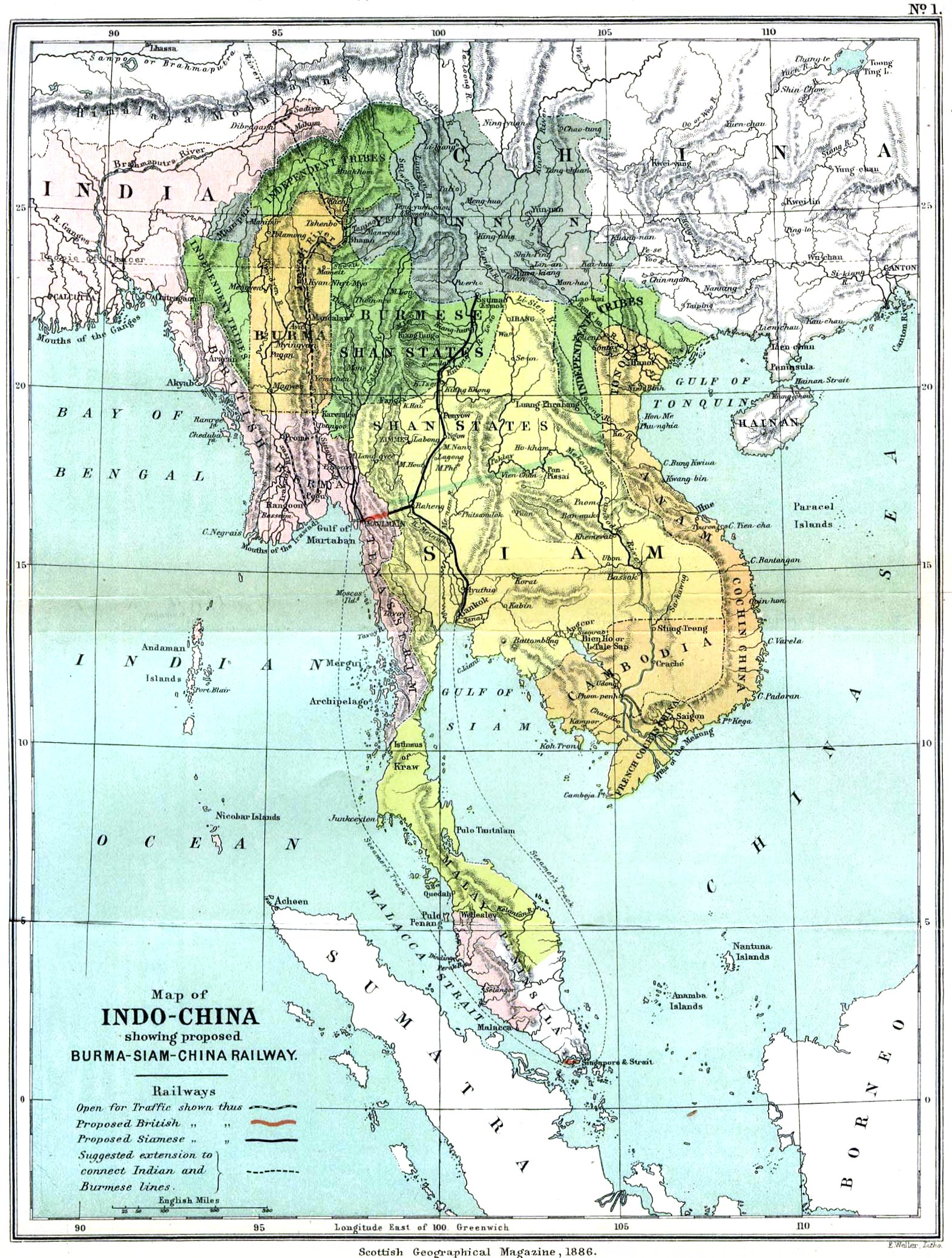
India + China = ?

Indochina: aptly named, not clearly defined.

I feel like its time to delve into the details of Indochina's history, location, and demographics. But first, an exploration in etymology. This is what I found for the origin of the word Indochina, from the Online Etymology Dictionary:
"1886, from Indo-, comb. form of Gk. Indos "India" + China. Name proposed early 19c. by Scottish poet and orientalist John Leyden, who lived and worked in India from 1803 till his death at 35 in 1811."

I think the late Leyden was not so much reflecting on the region's proximity to India and China. Rather, his poet's soul may have recognized the historical influence on the region by the two dominant adjacent civilizations. Much of their influence remains to this day. From the west, the Indian kingdom introduced Buddhism to all three nations, scripts based on Sanskrit to Laos and Cambodia, and Hindu temple architecture featured in places like Angkor Wat in Cambodia. And the eastern contribution, mostly adopted by Vietnam, includes Chinese script and vocabulary,  architecture, and world-views such as Taoism and Confucianism, the latter of which shaped Vietnam's social, political, and moral standards.

Leyden was not, and could not have been referring to the unified Southeast Asian territories of the French Empire known as French Indochina. He was long beyond this world when the French colonized Laos, Cambodia and Vietnam between 1858 and 1893 (1).

It seems the "conquistador's trinity"--gold, glory, and God--was at the core of the occupation. Catholic missionaries have ramped up efforts to save souls in SE Asia since Father Alexander De Rhodes started fussing around with the Vietnamese written language in the 17th century. Incidentally, De Rhodes's Romanization of the Vietnamese language marked the beginning of the end for both traditional Vietnamese and Chinese scripts in everyday usage. Another reason for French interest, the Indochinese region produced the kinds of commodities that enticed the European market, commodities like coffee, tea, wood, and labor. As my brother says, Vietnam is rich in resources, so it's a small wonder why a European power would want to claim it. Glory, well, that goes to the victorious.

So the French took over the three countries by seizing Vietnam by force, granting Cambodia protection, and receiving Laos by cession from Thailand. Occupation didn't sit well with Vietnam, and for years France was met by hostile Vietnamese resistance. The Japanese took over the region during World War II, and gave it back to France afterward. France maintained a tenuous grip on the region until it gave up possession as part of the Geneva Convention in 1954. That was the end of French Indochina. The region has been known as Indochina ever since.

Where is it?
There doesn't seem to be a consensus on what Indochina is. The most consistent definition I've seen is that the region is composed of three countries: Laos, Cambodia, and Vietnam. This definition seems to be a holdout term from the region's days as a French colony. Our oft-cited open source internet reference expands the region to include the countries of Thailand, Malaysia, Myanmar, and Singapore.

Indochina sits on the convergence of three tectonic plates: the Eurasian, the Indian-Australian, and the Pacific plates (2). As a result, there's a spine of mountains that runs from North to South. The big mountain range is the Annamese Cordillera. The Mekong River runs the border between Laos and Thailand, then cuts through Cambodia plateaus and then the coastal lowlands of southern Vietnam where it fans out into nine channels and dumps into the South China Sea.

Who's there?
Four-hundred years ago, people didn't move around much. Granted, you had large immigration movements from time to time, such as the movement of Viet and Han people into the southern Vietnam in the 17th century. But generally, people died in the villages where they were born. There wasn't as much getting around to be done as there is today. So it would have been easier back then to qualify who was where. Nowadays, I imagine it's quite a bit like herding cats. Everybody's moving around, and it's hard to say where anyone is from anymore. But let's give it a try, shall we?

In Cambodia, almost all of the people speak Khmer, an Austroasiatic language, which, like Vietnamese, is monosyllabic and tonal. The rest of Cambodians are made up of Chinese and Vietnamese diaspora, as well as Cham and Khmer Loeu peoples. Vietnamese, another Austroasiatic language, has much of its vocabulary borrowed from Chinese. There are 54 minority groups in Vietnam, each with a distinct language. In Laos, about half of people speak Laotian, yet another monosyllabic tonal language, although Laotian is in the Tai language group. The other half of Laos comprises speakers of various ethnic minority languages.

That about wraps it up for this post. This was probably a hard one to enjoy. If you followed along this far, you win a prize. Maybe a potato.

1. "Indochina." Encyclopædia Britannica. Encyclopædia Britannica Online. Encyclopædia Britannica, 2011. Web. 10 Jun. 2011. http://www.britannica.com.ezproxy2.library.arizona.edu/EBchecked/topic/286431/Indochina.

2. "Southeast Asia." Encyclopædia Britannica. Encyclopædia Britannica Online. Encyclopædia Britannica, 2011. Web. 10 Jun. 2011. http://www.britannica.com.ezproxy2.library.arizona.edu/EBchecked/topic/556489/Southeast-Asia.

Provender:
- breakfast: leftover cháo, omelette and stir fried veggies
- lunch: cà ri bò with organ meats and baguette
- dinner: pumpkin pizza at Boomerang Cafe in Tân Phú