Saturday, June 11, 2011

Bottom's Up

Can I interest you in a nice cold beverage?
1. green tea7. green herbs13. wintermelon
2. green orange 8. herbal tea14. grass jelly
3. tamarind9. orange15. soy milk
4. passion fruit10. lychee16. root beer
5. bird's nest11. passion fruit17. pink guava
6. aloe12. tamarind18. soursop

One of the things I like to do in foreign countries is to check out packaged goods to see how they're different from home. I'm not sure any of our vending machines offer eighteen different types of drinks. I usually see only five or six flavors in ours. And some of these cans cost 7000₫, which is around 35 cents.

Of course, there are things in the vending machines in other countries that you'd never expect to see in a vending machine in the states. I've seen ones that dispense beer, hard alcohol, umbrellas, iPods, and underwear. Just in case you run out, I guess. This particular vending machine sells bird's nest drink. But that's a very popular beverage all around the world. And based on this price tag, it's quite affordable here.

Provender
- breakfast: xôi thập cẩm
- lunch: miến gà

Friday, June 10, 2011

India + China = ?

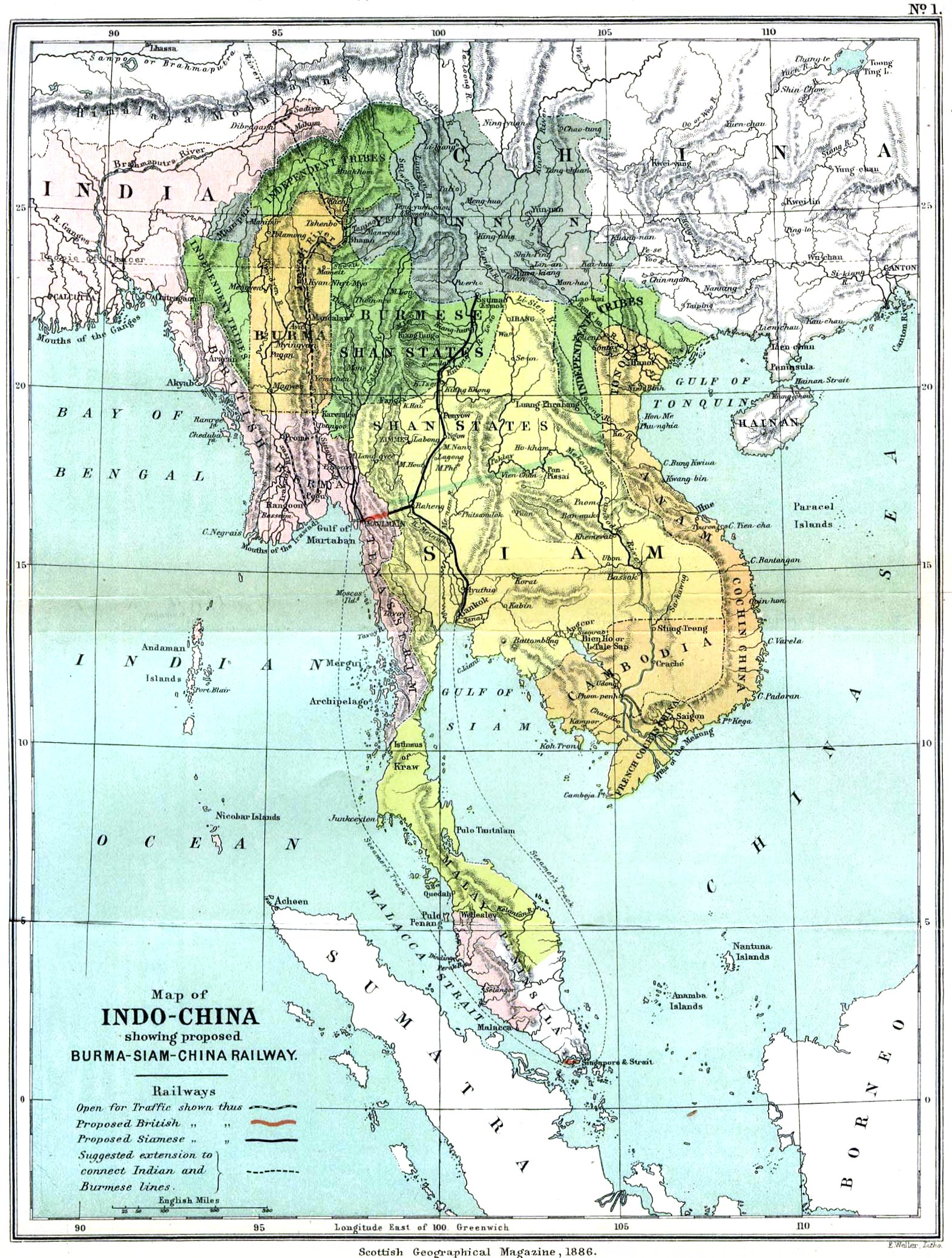
Indochina: aptly named, not clearly defined.

I feel like its time to delve into the details of Indochina's history, location, and demographics. But first, an exploration in etymology. This is what I found for the origin of the word Indochina, from the Online Etymology Dictionary:
"1886, from Indo-, comb. form of Gk. Indos "India" + China. Name proposed early 19c. by Scottish poet and orientalist John Leyden, who lived and worked in India from 1803 till his death at 35 in 1811."

I think the late Leyden was not so much reflecting on the region's proximity to India and China. Rather, his poet's soul may have recognized the historical influence on the region by the two dominant adjacent civilizations. Much of their influence remains to this day. From the west, the Indian kingdom introduced Buddhism to all three nations, scripts based on Sanskrit to Laos and Cambodia, and Hindu temple architecture featured in places like Angkor Wat in Cambodia. And the eastern contribution, mostly adopted by Vietnam, includes Chinese script and vocabulary,  architecture, and world-views such as Taoism and Confucianism, the latter of which shaped Vietnam's social, political, and moral standards.

Leyden was not, and could not have been referring to the unified Southeast Asian territories of the French Empire known as French Indochina. He was long beyond this world when the French colonized Laos, Cambodia and Vietnam between 1858 and 1893 (1).

It seems the "conquistador's trinity"--gold, glory, and God--was at the core of the occupation. Catholic missionaries have ramped up efforts to save souls in SE Asia since Father Alexander De Rhodes started fussing around with the Vietnamese written language in the 17th century. Incidentally, De Rhodes's Romanization of the Vietnamese language marked the beginning of the end for both traditional Vietnamese and Chinese scripts in everyday usage. Another reason for French interest, the Indochinese region produced the kinds of commodities that enticed the European market, commodities like coffee, tea, wood, and labor. As my brother says, Vietnam is rich in resources, so it's a small wonder why a European power would want to claim it. Glory, well, that goes to the victorious.

So the French took over the three countries by seizing Vietnam by force, granting Cambodia protection, and receiving Laos by cession from Thailand. Occupation didn't sit well with Vietnam, and for years France was met by hostile Vietnamese resistance. The Japanese took over the region during World War II, and gave it back to France afterward. France maintained a tenuous grip on the region until it gave up possession as part of the Geneva Convention in 1954. That was the end of French Indochina. The region has been known as Indochina ever since.

Where is it?
There doesn't seem to be a consensus on what Indochina is. The most consistent definition I've seen is that the region is composed of three countries: Laos, Cambodia, and Vietnam. This definition seems to be a holdout term from the region's days as a French colony. Our oft-cited open source internet reference expands the region to include the countries of Thailand, Malaysia, Myanmar, and Singapore.

Indochina sits on the convergence of three tectonic plates: the Eurasian, the Indian-Australian, and the Pacific plates (2). As a result, there's a spine of mountains that runs from North to South. The big mountain range is the Annamese Cordillera. The Mekong River runs the border between Laos and Thailand, then cuts through Cambodia plateaus and then the coastal lowlands of southern Vietnam where it fans out into nine channels and dumps into the South China Sea.

Who's there?
Four-hundred years ago, people didn't move around much. Granted, you had large immigration movements from time to time, such as the movement of Viet and Han people into the southern Vietnam in the 17th century. But generally, people died in the villages where they were born. There wasn't as much getting around to be done as there is today. So it would have been easier back then to qualify who was where. Nowadays, I imagine it's quite a bit like herding cats. Everybody's moving around, and it's hard to say where anyone is from anymore. But let's give it a try, shall we?

In Cambodia, almost all of the people speak Khmer, an Austroasiatic language, which, like Vietnamese, is monosyllabic and tonal. The rest of Cambodians are made up of Chinese and Vietnamese diaspora, as well as Cham and Khmer Loeu peoples. Vietnamese, another Austroasiatic language, has much of its vocabulary borrowed from Chinese. There are 54 minority groups in Vietnam, each with a distinct language. In Laos, about half of people speak Laotian, yet another monosyllabic tonal language, although Laotian is in the Tai language group. The other half of Laos comprises speakers of various ethnic minority languages.

That about wraps it up for this post. This was probably a hard one to enjoy. If you followed along this far, you win a prize. Maybe a potato.

1. "Indochina." Encyclopædia Britannica. Encyclopædia Britannica Online. Encyclopædia Britannica, 2011. Web. 10 Jun. 2011. http://www.britannica.com.ezproxy2.library.arizona.edu/EBchecked/topic/286431/Indochina.

2. "Southeast Asia." Encyclopædia Britannica. Encyclopædia Britannica Online. Encyclopædia Britannica, 2011. Web. 10 Jun. 2011. http://www.britannica.com.ezproxy2.library.arizona.edu/EBchecked/topic/556489/Southeast-Asia.

Provender:
- breakfast: leftover cháo, omelette and stir fried veggies
- lunch: cà ri bò with organ meats and baguette
- dinner: pumpkin pizza at Boomerang Cafe in Tân Phú

A New Horizon

Today marks the eighth post I've made since I resurrected this blog for the trip to Vietnam. Eight posts in as many days is practically a milestone. To compare my blogging now to my efforts two years ago would show an exponential improvement--a lion to a mouse. I began this blog to document my experience in East Asia from June 2009 to May 2010. In the entire year I spent studying abroad, I posted eleven entries--not even once a month.

This blog used to be titled Riffing China. In fact, the old title is still in the URL. I think I'll leave it there as a reminder of this blog's beginnings. The title had emerged through conversations about how I was going to document my travels and keep in touch with people at home. My sister was the one who suggested the word "riffing." It turned out to be the perfect word. It captured not only my pledge to produce thoughtful responses to the sights and events I experienced during my travels, but also carried a personal touch because, hey, I play guitar. When I think of riffing, I think of creative expression, melodic illustration of thought or emotion, with fingers dancing on a fretboard to tell the story of life through song. I think it's an awesome, inspirational word and I'm grateful for her suggestion.

To me, the word choice of China is as meaningful as the idea of China is complex. Together with the word riffing, the title reflects my goal to learn and write about one of the world's oldest and most influential civilizations. It was also meaningful because I realized I knew almost nothing about China but had many assumptions and associations. Five years ago, all I knew about China was the red flag with five yellow stars, the Communist influence on Korea, and the cultural influence on Japan that included the plow, chopsticks, and written language. I knew there were one billion people living in China, with a one-family, one-child policy. I knew US citizens have a ridiculous love-hate relationship with inexpensive Chinese-made imported goods. And really, that was about it. Without knowing the gravity of the error, I had consolidated everything Chinese and placed it under the umbrella of the People's Republic of China, or PRC. It wasn't until this study abroad experience that I first learned there are actually two nations called China: the PRC and Taiwan, officially known as the Republic of China.

My old definition of China as a country was just tossed out the window. How can China be a country if there are two of them? While I was in Taiwan, I was enrolled in a program called cultural immersion, where we spent 13 hours each day talking in only Mandarin. We were instructed in manners and social norms. We learned about history, about social identity. We started to understand China as being an idea that reflected a global culture that is exceptionally diverse, even among Chinese provinces. To say China is not to say Ireland, or Italy. It's more like saying Europe, in the sense that both comprise various regions that are unified by a sense of common identity.

Defining China as a culture, not a country, was the beginning of my journey. Everywhere I studied, indeed everywhere I traveled in Asia, the influence of Chinese culture was extensive. It's the culture of China--the language, the values, the history--that I explored during my year abroad, because Chinese culture is dominant in Taiwan, Hong Kong, and Singapore where I studied, and yet so different in each. Chinese culture is also greatly influential in Malaysia and Indonesia, two other places I went.

In establishing Riffing China, I had pledged to riff ecstatic about my experiences with Chinese culture. It was a pledge I hardly lived up to. Eleven posts is insufficient to document a two week vacation in a land of exceptional beauty, exotic culture, and food of limitless tastes and flavors, let alone an entire year in six countries. Like so many good intentions, efforts to write blog posts fell by the wayside.

In my defense, I'd like to think I put the time not blogging to good use. In Taiwan and Singapore, I spent more time studying than ever before, mostly because I desperately needed to; although, I learned a great deal about ethics and communication. And in Hong Kong, I lived a rich life of travel, arts, and social activity that would never have been possible at a more challenging university. The same can be said for my brief stays in Bali, southern Malaysia, and Guangxi, China--I lived in the moment and lived well. Yet my experiences were largely recorded only by my (tenuous) memory. The blog doesn't even mention Malaysia, Indonesia, or even the week I spent in China. Riffing China could be best summed up by one term: fail blog.

So a reimagining is in order. In a saccharine poetic cliché, the old blog burned and has become reborn as Riffing Indochina. This new iteration of riffing will record life in Saigon, travels within Vietnam, and trips planned for Thailand and Cambodia with Mike and Lữ. Furthermore, this blog will also serve to breathe life into new opportunity, a second chance to contemplate and record my experiences during the year studying abroad. My time here so far has already presented numerous parallels that I can't wait to share in further posts. After all, the cultural landscape of Vietnam is largely a result of exchange between the Việt people and the Southern Chinese throughout history. In particular, I am passionate to learn about how and why the two cultures have an overlap of cuisine, written and spoken language, and ontology. It's fascinating to me, and I wish to share with you what I learn. Please comment, criticize, contribute. In the meantime, check back from time to time, because this will continue. I will be reminded of old experiences as I have new ones. I will reflect on them both. I will riff.

For who? Well, for you, I hope.